Agentic AI TMS Procurement Framework: How European Buyers Can Evaluate Autonomous Decision-Making Systems Without Joining the 76% Implementation Failure Rate

European procurement teams evaluating agentic AI TMS platforms face a deceptive procurement challenge. While 79% of organizations have adopted AI agents to some extent, Gartner predicts over 40% of agentic AI projects will be canceled by end of 2027, while seventy-six percent of logistics transformations never fully succeed, failing to meet critical budget, timeline or KPI metrics. The difference between autonomous decision-making systems that actually execute versus those that merely suggest actions requires specialized procurement frameworks that most European buyers lack.
Understanding True Agentic Capabilities vs Marketing Hype
Conventional TMS platforms analyze data and suggest actions for human approval. Agentic AI systems fundamentally differ by autonomously assigning shipments, scheduling pickups, and adjusting routes during disruptions without human intervention. MIT research shows 95% of agentic AI pilots fail. The problem isn't technology limitations—it's approach. Only 15-20% deployed agents in production workflows touching real customers or critical business processes.
Many organizations use hard-coded rule-based matching with small rule-sets, resulting in higher abandonment and perceived failures. According to BCG, agentic systems already accounted for 17% of total AI value in 2025 and are projected to reach 29% by 2028, with these agents reasoning through complex logic chains, querying disparate systems (ERP, WMS, TMS), and triggering actions without constant human oversight.
When evaluating genuine autonomous decision-making capabilities, examine vendors like MercuryGate (now Infios), Blue Yonder, Manhattan Active, Cargoson, and nShift for their ability to execute decisions rather than just recommend them. Trimble's Order Intake Agent eliminates manual review in 90% of standard order entries by quickly processing orders received through various channels including email, PDFs and EDI, entering data directly into the TMS for review.
European Regulatory Compliance Requirements for Autonomous Systems
As of January 2026, eFTI platforms and service providers can start preparing for operations while Member States authorities may start accepting data stored on certified eFTI platforms for inspection. By July 2027, all Member States will be required to accept electronic transport data via eFTI-certified platforms.
From July 1, 2026, vans weighing 2.5-3.5 tons performing international transport will be subject to second-generation smart tachographs (G2V2). Simultaneously, as of 1 January 2026, the transitional phase of the Carbon Border Adjustment Mechanism (CBAM) has ended with importers now subject to full financial obligations.
European agentic AI must handle these requirements as core functionality, not bolt-on modules. European-native TMS vendors like Cargoson and Alpega maintain development resources focused exclusively on European market needs, providing advantages over global vendors treating European compliance as secondary requirements. This becomes particularly relevant when French carriers use different API standards than German logistics providers. Scandinavian forwarders require specialized integration approaches. Your agentic system must understand these variations and route decisions accordingly—automatically selecting German carriers for German domestic legs and switching to pan-European providers for cross-border segments.
Implementation Risk Assessment Framework
The phased approach reduces catastrophic failure risk. European regulatory timelines provide natural implementation phases: core functionality validation in Q2-Q3 2025, eFTI readiness by January 2026, G2V2 integration by July 2026. This phased approach reduces risk while ensuring your organization benefits from agentic AI capabilities without joining the majority of implementations that fail to deliver their promised value.
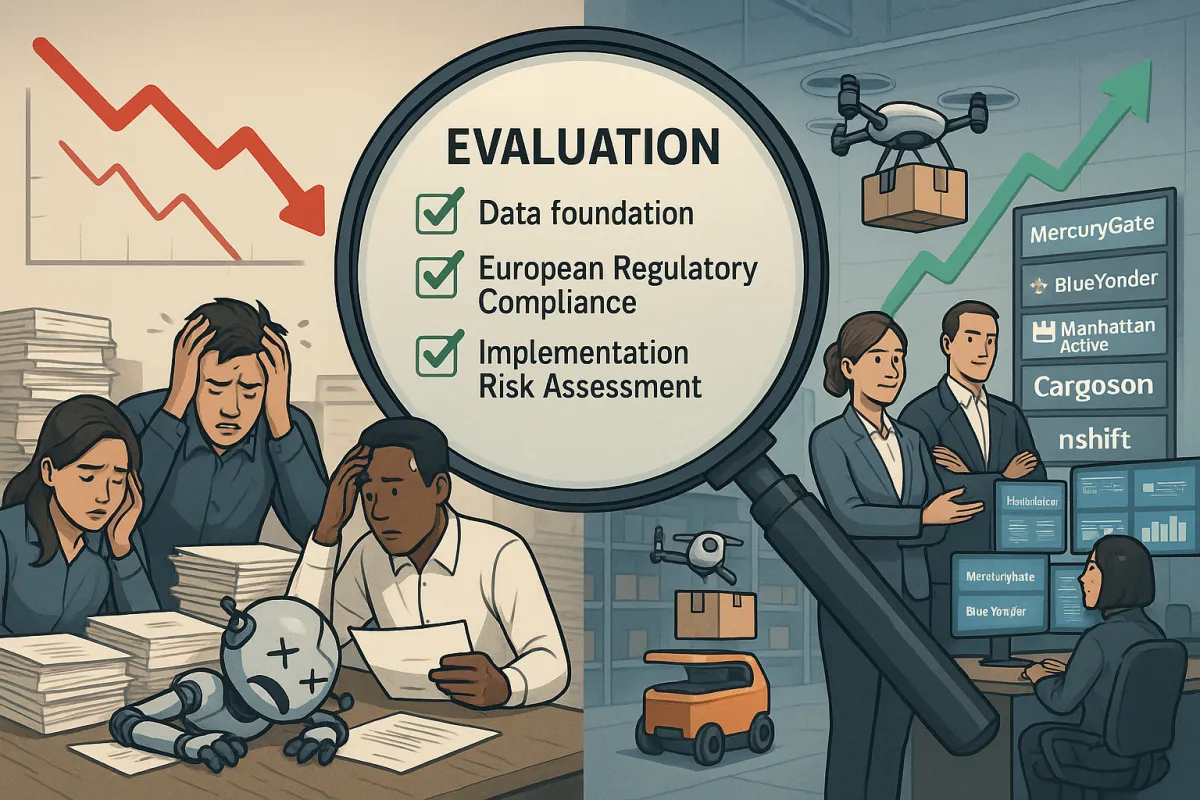
Data foundation issues create the most failures. Agentic AI implementation success depends entirely on data foundation quality, yet most organizational data isn't positioned to be consumed by agents that need to understand business context and make decisions. Your master data for carriers, routes, and performance metrics must be clean, standardized, and accessible before any agent can function reliably.
Implementation timelines vary significantly: TMS implementation usually takes 1-2 months for smaller shippers and 3-6 months for larger, more complex networks. European operations typically fall between these ranges due to cross-border complexity. Test specific corridors rather than attempting full transformation immediately—bounded scope with single workflow, clear success criteria, and measurable ROI.
Vendor Consolidation Impact on Autonomous AI Roadmaps
WiseTech's acquisition of E2open in 2025, Descartes' purchase of 3GTMS for $115 million in March 2025, and Körber's transformation of MercuryGate into Infios following their 2024 acquisition represent just the beginning of a fundamental market restructuring. WiseTech Global's $2.1 billion acquisition of E2open is more than a headline—it's a directional shift for one of the industry's biggest technology players.
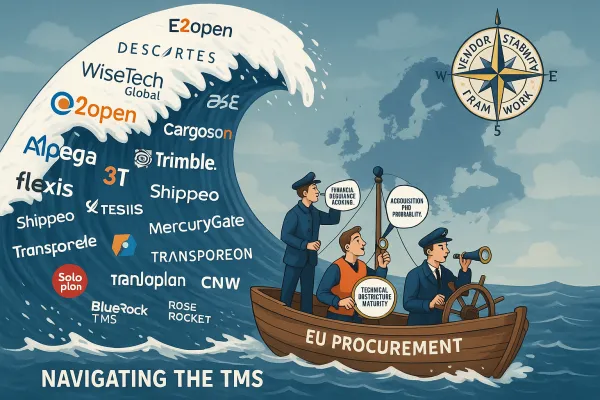
Three emerging categories define the post-consolidation landscape: global mega-vendors (Oracle TM, SAP TM, E2open/WiseTech, Descartes/3GTMS), European specialists (Alpega, nShift, Transporeon), and European-native solutions like Cargoson that focus specifically on cross-border European operations.
Companies undergoing integration often experience 12-18 months of reduced innovation while they harmonize platforms and teams. Cargoson, Alpega, and other European specialists maintain development resources focused exclusively on European market needs, while global vendors like Descartes or WiseTech spread development efforts across multiple geographic priorities.
Cost and ROI Evaluation Methodology
Companies report average returns on investment (ROI) of 171%, with U.S. enterprises achieving around 192%, which exceeds traditional automation ROI by 3 times. However, 88% of AI agents fail to reach production — but the survivors return 171% ROI. The problem is not agent technology — it is the infrastructure, governance, and evaluation frameworks that separate the 12% who succeed from the 88% who do not.
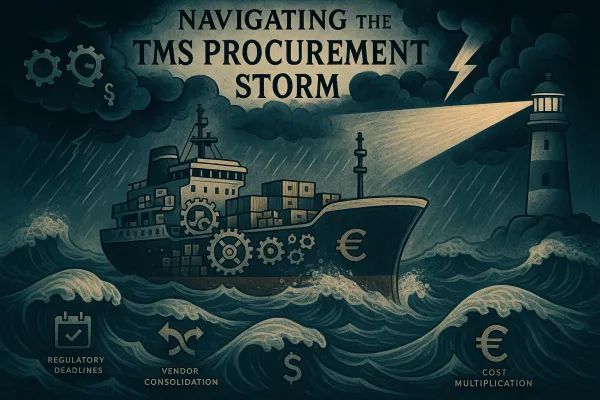
Hidden costs destroy most budgets. Basic API integrations cost €5,000-€15,000, while complex ERP connections exceed €50,000. For shippers with annual freight under management exceeding €250M, implementation costs often run 2-3x the subscription fees. Add regulatory compliance requirements and costs multiply exponentially.
Recent implementations show dramatic results: Freight Technologies reported 15x domestic efficiency and 5x cross-border acceleration after deploying agentic AI across their platform, handling higher volumes with roughly half the prior operations headcount. Organizations using agentic AI systems can realize double-digit efficiency gains and reduce decision latency from days to seconds.
European manufacturers report improved carrier relationships, reduced cross-border documentation errors, and faster urgent capacity response times. When evaluating TCO, include Cargoson alongside major vendors like Descartes and MercuryGate, examining both implementation complexity and ongoing operational costs.
Practical Procurement Action Plan and Implementation Timeline
By December 2026, every serious organization will be running at least one agentic 'factory' directly tied to revenue growth or risk reduction. In 2026, experimentation gives way to execution; agentic systems move from pilot to mainstream production.
The 90-day window reflects urgent reality. European shippers who establish governance frameworks now position themselves for expansion when procurement and integration typically require 12-15 months for complex European operations. Strategic positioning matters more than price optimization when productivity differentiates winners from the 76% who fail.
Phase 1: Vendor Stability Assessment (Days 1-30)
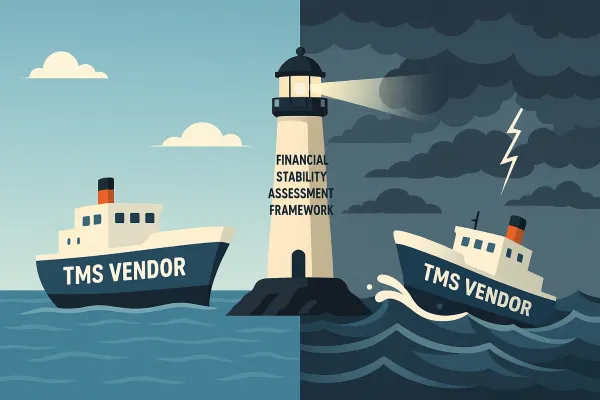
Examine financial stability beyond current revenue. The deal marks Descartes' 32nd acquisition since 2016. This aggressive acquisition pattern indicates further consolidation ahead. Include acquisition notification requirements and price protection clauses in contract negotiations.
Phase 2: Pilot Program Design (Days 31-60)
Focus on single-corridor testing with bounded scope. Establish success criteria that measure operational impact: cost reduction, service level improvements, cycle time compression, and planner productivity gains. Avoid automation rates as primary success metrics.
Phase 3: Scaled Implementation (Days 61-90)
The 12% who succeed share four attributes: pre-deployment infrastructure investment, governance documentation before deployment, baseline metrics captured before pilots, and dedicated business ownership with accountability for post-deployment performance.
Your procurement framework must address the convergence of agentic AI capabilities, European regulatory requirements, and vendor consolidation risks simultaneously. European shippers who master this evaluation approach avoid joining the 76% failure rate while positioning themselves for autonomous transportation management that delivers measurable competitive advantages.