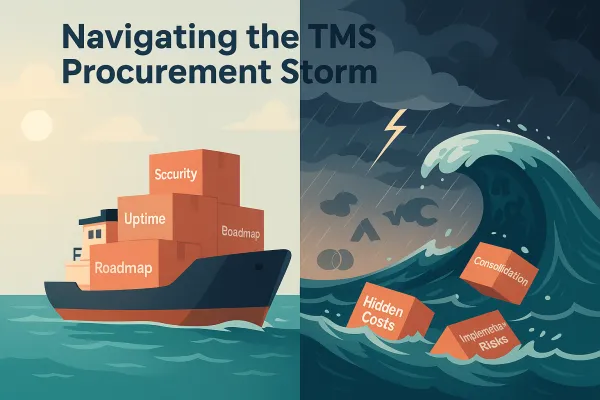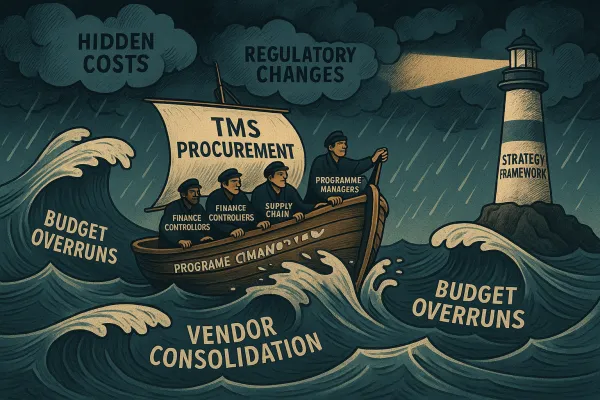
TMS Contract Penalties That Actually Work: The European Procurement Framework for Enforceable Liquidated Damages That Protect Against eFTI and Compliance Failures

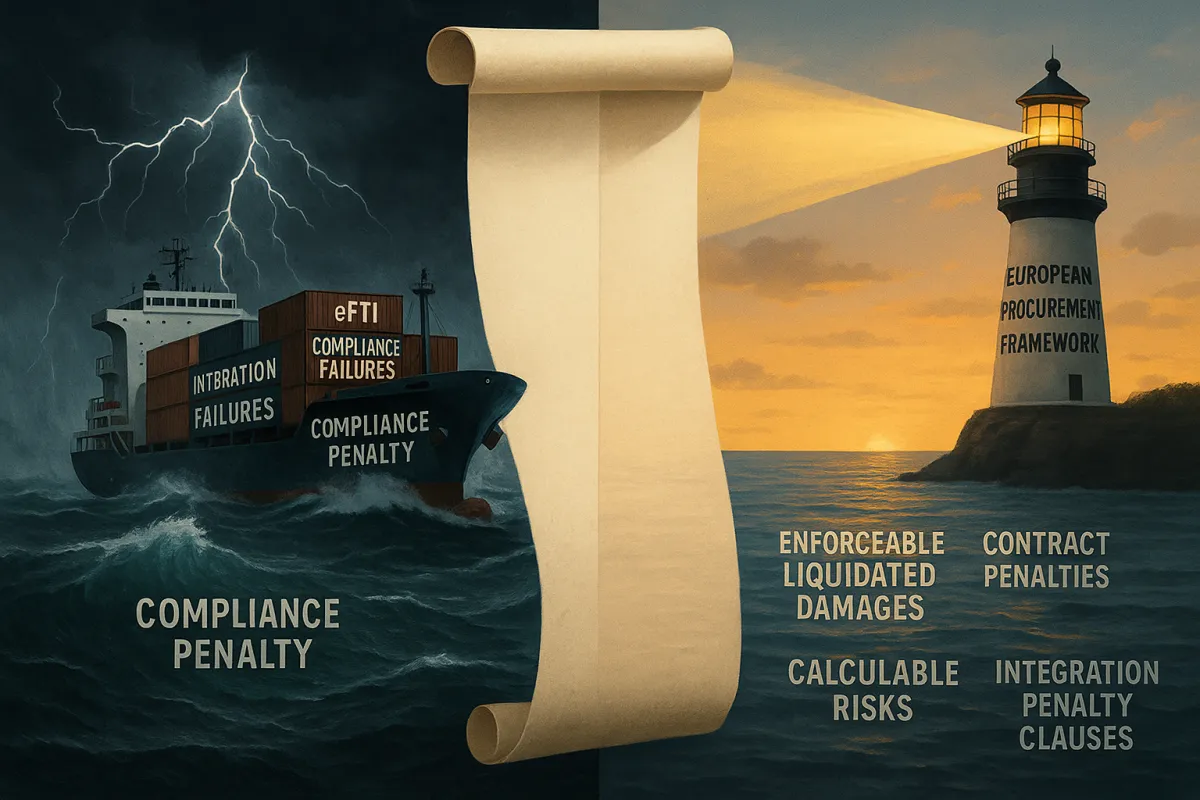
European procurement teams face a critical challenge in 2026: according to the Standish Group's Annual CHAOS 2020 report, 66% of technology projects end in partial or total failure, while TMS contracts worth hundreds of thousands of euros lack proper penalty clauses that protect against regulatory compliance failures. A German automotive parts manufacturer discovered this the expensive way. After selecting their TMS based on a feature comparison spreadsheet, they faced €800,000 in additional costs when carrier integration failures emerged post-acquisition of their chosen vendor.
The stakes have never been higher. Failure to comply with the regulations can result in severe penalties, which in some countries can reach up to 30,000 euros, and carriers and importers must integrate ERP and TMS systems with the ICS2 platform, with failure to report potentially resulting in a fine of up to 5,000 euros, especially with a large volume of shipments.
Traditional penalty clauses that worked for basic software licensing fall apart when courts scrutinize them under real legal pressure. The difference between an enforceable liquidated damages clause and one that gets struck down comes down to meeting two specific legal tests most procurement teams never learn.
Legal Reality Check: Liquidated Damages vs. Unenforceable Penalties
Your contract penalties need to pass a two-part legal test to survive court challenges. The UK Supreme Court's decision in Cavendish Square Holding BV v. Makdessi (2015) established a new precedent. The court held that: «A clause will be enforceable if it protects a legitimate interest of the innocent party and the amount is not out of proportion to that interest».
European courts apply this test differently than common law jurisdictions, which works in your favor. On the contrary, in almost all European contract laws liquidated damages are readily enforced, as are penalty clauses when they are not manifestly excessive.
The critical distinction: the amount specified in such a clause is determined at the time of contracting and becomes payable automatically upon breach, without the need to prove the extent of harm—provided the clause is enforceable under the applicable law. Your job is structuring clauses that meet enforceability requirements while providing real financial protection.
German law provides specific guidance: Contractual penalties are enforceable under German law, but are subject to reduction by courts if they are excessively high. The key word is "excessively" - reasonable penalties tied to probable losses get upheld.
The 2026 Regulatory Compliance Penalty Framework
eFTI and Smart Tachograph compliance aren't optional upgrades anymore - they're baseline operational requirements that create specific, calculable risks. As of 9 July 2027: The eFTI Regulation will apply in full. Member State authorities must accept information shared electronically by operators via certified eFTI platforms.
This creates your first enforceable penalty category. eFTI non-compliance penalties should reflect the operational disruption caused by manual paper-based processes after the mandate. This process is often paper-based, time-consuming and error-prone, leading to delays, a high administrative burden and unnecessary costs.
CBAM compliance creates another penalty opportunity. As of 1 January 2026, the transitional phase of the Carbon Border Adjustment Mechanism (CBAM) has ended and the definitive phase has begun... From January 2026, methane (CH₄) and nitrous oxide (N₂O) emissions from maritime transport will also fall under the EU ETS... Transport management systems must track and report these expanded emissions categories for compliance and carbon cost management.
Structure your penalty amounts based on actual compliance costs. For eFTI violations, calculate the cost difference between electronic and paper-based processing across your shipment volume. For CBAM failures, model the financial exposure from missing carbon reporting deadlines.
Implementation and Integration Penalty Clauses
Basic API integrations cost €5,000-€15,000, while complex ERP connections exceed €50,000. A basic domestic shipper requires 10-15 integrations minimum, potentially totaling 1,000-1,500 hours of labor. These aren't theoretical numbers - they represent probable losses courts will recognize.
Implementation costs range from €30,000 to €900,000, and for shippers with freight spend exceeding $250M annually, implementation can cost 2-3 times the subscription fee. Your penalty clauses should reflect these realistic cost ranges, not arbitrary round numbers.
The "long pole" problem creates another penalty opportunity. The "long pole of the tent" of implementation time, and therefore cost, resides in the design, build, and testing of integrations. When vendors miss integration milestones, your penalty should compensate for extended project timelines and resource allocation.
Vendor Consolidation Protection Clauses
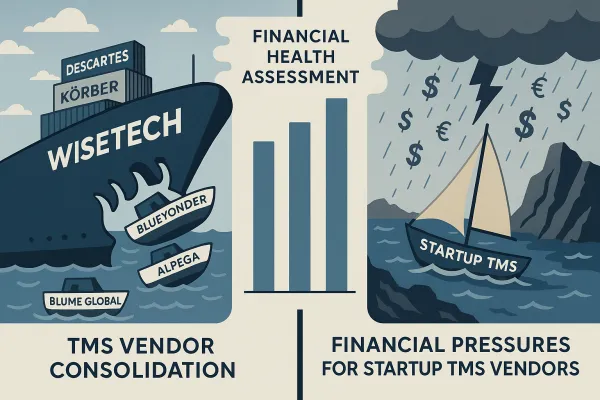
The current consolidation wave creates new risk categories courts haven't seen before. WiseTech's acquisition of e2open for $3.30 per share in cash equating to an enterprise value of $2.1 billion marks the largest TMS industry acquisition to date, while Descartes Systems Group has acquired Columbus, Ohio-based 3Gtms for $115 million USD in cash, reshaping vendor options for European buyers.
Your contracts need specific language: Include specific clauses requiring 12-18 months advance notice of ownership changes, with automatic contract review rights triggered by acquisition announcements. Price protection clauses should lock pricing for 24 months following ownership changes, preventing immediate cost increases during integration periods. Functionality guarantee clauses protect against feature deprecation common during platform consolidation.
Bulletproof Contract Language Templates
Courts scrutinize three criteria when evaluating penalty clauses: damages must be hard to estimate, the penalty amount must be a reasonable estimate of probable loss, and the clause must compensate rather than punish.
Here's enforceable language for regulatory compliance penalties:
"In the event Vendor fails to deliver fully functional eFTI compliance capabilities by [specific date], Vendor shall pay Client liquidated damages of [€X] per business day of delay, representing the additional administrative costs and operational disruption caused by manual paper-based processing, which damages are acknowledged by both parties to be difficult to ascertain and this amount represents a reasonable estimate thereof."
For integration failures, use this structure:
"Should Vendor fail to complete carrier integration milestones per the agreed timeline, Vendor shall compensate Client for extended implementation costs at [€X] per week of delay, calculated based on the additional internal resources, consultant fees, and project management overhead required to maintain implementation momentum."
Notice the specific language: "difficult to ascertain," "reasonable estimate," and direct correlation to probable costs. This wording survives legal challenges because it meets the European enforceability standards.
The TCO-Linked Penalty Calculator
Your penalty amounts need mathematical justification to survive court review. Base calculations on documented TCO components: Licensed TMS software runs $50,000-$400,000+ with annual maintenance charges ranging from 15-20% of license costs, with a 100-truck operation's initial $100,000 investment becoming $200,000+ in the first year when factoring in implementation, training, and infrastructure requirements.
Budget modeling provides penalty benchmarks: Plan for 15-20% budget increases in 2026-2027 if reactive, or 8-12% if proactive with proper contract protection. Use the reactive cost increase (15-20%) as your penalty ceiling - courts consider this reasonable since it represents actual business impact.
For regulatory compliance penalties, model the cost differential. If manual processes cost 15% more than automated compliance, your daily penalty for eFTI non-compliance should reflect this operational impact across your shipment volume.
Negotiation Tactics: Using Regulatory Pressure as Leverage
The 2026 regulatory convergence gives you unprecedented negotiation power. The regulatory convergence gives procurement teams unprecedented negotiation leverage. Vendors need to prove compliance capabilities to win deals, creating opportunities for more favorable contract terms.
Vendors need reference customers for their compliance implementations. Vendors need reference customers for their eFTI and Smart Tachograph integrations, allowing you to position your organization as an early adopter in exchange for better base terms, implementation support, and protection against compliance-related cost increases.
Structure compliance as vendor obligation, not buyer option: Any TMS contract signed now should include eFTI and Smart Tachograph compliance as baseline requirements, not optional upgrades. This shifts implementation risk to vendors and creates penalty opportunities when they fail to deliver.
Your negotiation timeline matters. The procurement window for securing optimal TMS platforms before vendor consolidation eliminates choices and capacity shortages worsen cost structures runs through Q1 2026... This gives you approximately 3-4 months of leverage before capacity tightens again.
Use regulatory deadlines as milestone penalties. Vendors claiming January 2026 eFTI readiness should accept financial penalties if they miss this timeline. Vendors claiming eFTI readiness should demonstrate functional integration by January 2026, not just promise compliance by the July 2027 mandate.
The most effective penalty clauses combine reasonable amounts with operational reality. Courts uphold clauses that reflect genuine business consequences while rejecting those designed purely to punish. European procurement teams who master this balance protect themselves against the compliance disasters and vendor failures hitting TMS implementations from vendors like Cargoson, MercuryGate, Descartes, and Oracle TM.
Your penalty clauses should work as insurance policies - you hope never to use them, but when vendor failures threaten compliance deadlines or budget overruns, properly structured liquidated damages provide the financial protection and legal leverage you need to survive implementation disasters.