TMS Vendor Stability Assessment: The European Procurement Scorecard That Prevents €800K Implementation Disasters During 2026's Historic Consolidation Wave

A German automotive parts manufacturer learned the €800,000 lesson about TMS vendor stability the hard way. After selecting their TMS based on a feature comparison spreadsheet, they faced €800,000 in additional costs when carrier integration failures emerged post-acquisition of their chosen vendor. Their vendor looked solid on paper until WiseTech Global's $2.1 billion acquisition of E2open and Descartes Systems Group's acquisition of 3GTMS for USD 115 million in March 2025 signal the most significant vendor consolidation wave in TMS market history.
The stakes couldn't be higher. According to the Standish Group's CHAOS 2020 report, 66% of technology projects end in partial or total failure, with McKinsey research showing that 17% of large IT projects threaten the very existence of the company. During the most significant TMS vendor consolidation wave in over a decade, European procurement teams need frameworks that protect against implementation disasters when vendor relationships suddenly shift.
The New Reality: When Vendor Consolidation Meets Procurement Risk
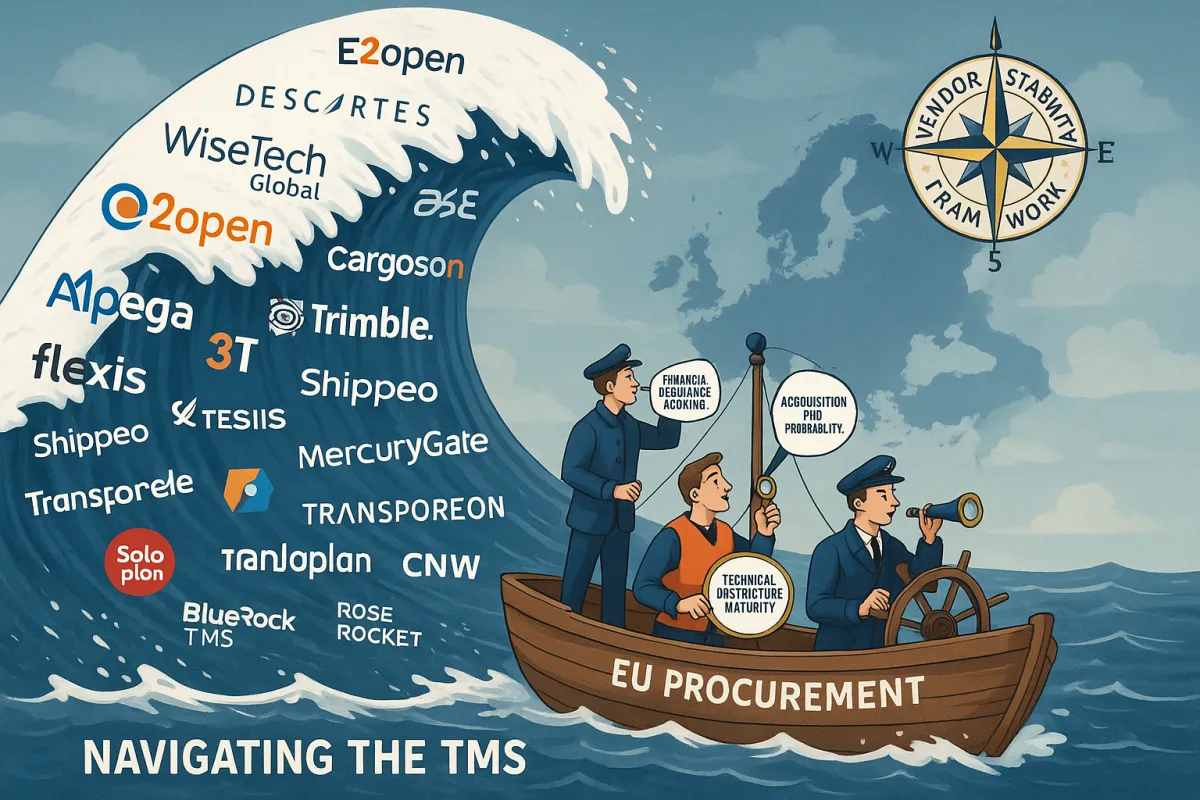
WiseTech's acquisition of E2open in 2025, Descartes' purchase of 3GTMS for $115 million in March 2025, and Körber's transformation of MercuryGate into Infios following their 2024 acquisition represent just the beginning of a fundamental market restructuring that's forcing European shippers to reconsider their entire TMS procurement strategy.
The numbers tell a concerning story. The European TMS market, valued at €1.4 billion in 2024 and growing at a compound annual growth rate of 12.2 percent, is forecasted to reach €2.5 billion by 2029. This growth coincides with unprecedented consolidation that's eliminating choice and creating new risks for procurement teams who thought they had plenty of time to evaluate options.
The consolidation creates three distinct vendor categories for evaluation: global mega-vendors (Oracle TM, SAP TM, E2open/WiseTech), European specialists (Alpega, nShift, Transporeon), and emerging European-native solutions like Cargoson that focus specifically on cross-border European operations. Cargoson, Alpega, and other European specialists maintain development resources focused exclusively on European market needs, while global vendors like Descartes or WiseTech spread development efforts across multiple geographic priorities. This focus translates into faster feature development for European-specific requirements and more responsive customer support during regulatory transitions.
The 6-Dimension Vendor Stability Framework
Traditional feature checklists miss the fundamental risks reshaping TMS procurement. Our assessment framework addresses six critical dimensions that predict vendor stability during market consolidation.
Financial Resilience Scoring
Revenue concentration analysis reveals critical vulnerabilities. Revenue concentration analysis reveals whether vendors depend on a few large customers whose requirements may not align with yours post-acquisition. Calculate the percentage of vendor revenue from their top three customers. Any vendor deriving more than 40% of revenue from three clients faces significant risk if those relationships change.
Examine private equity involvement and debt structures, not just revenue growth. Private equity-backed vendors often face pressure to demonstrate exit value within 3-5 years, making them attractive acquisition candidates. Request debt-to-equity ratios and cash flow statements from the past three years to identify financial stress indicators.
Acquisition Risk Probability
Market positioning determines acquisition likelihood. Track acquisition target likelihood by monitoring vendor hiring patterns, investment rounds, and market positioning statements. Vendors aggressively hiring sales staff while reducing R&D investment often signal preparation for sale.
Strategic value assessment requires understanding which capabilities larger vendors lack. Identify potential acquirers by analyzing which larger players lack capabilities in your vendor's specialization areas. European regulatory compliance expertise, for instance, makes vendors attractive to global players seeking regional expansion.
Technical Architecture Maturity
API versioning policies reveal integration stability commitments. Vendors maintaining backward compatibility for less than 24 months indicate architectural instability that worsens during acquisitions. When two TMS platforms merge, customers inevitably face decisions about which system to standardize on, what features will be deprecated, and how long dual support will continue.
Cloud architecture assessment requires examining multi-tenancy implementation and disaster recovery capabilities. Single-tenant architectures create higher maintenance costs that become targets for elimination during consolidation.
European Compliance Readiness
Regulatory timeline alignment provides negotiation leverage. As of 9 July 2027, the eFTI Regulation will apply in full, while starting 19 August 2025, all heavy-duty vehicles registered in the EU and operating in Member States other than their Member State of registration must be fitted with G2V2 devices. These regulatory deadlines create negotiation leverage that savvy buyers can exploit for better contract terms and protection against vendor lock-in.
CBAM (Carbon Border Adjustment Mechanism) definitively applies from 2026 after the transitional phase ends. TMS platforms must integrate carbon reporting capabilities with customs documentation workflows. Vendors demonstrating integrated CBAM compliance show commitment to European market requirements beyond basic transport management.
Geographic Commitment Indicators
Development team location analysis reveals post-acquisition priorities. This geographic and market focus shift creates uncertainty about European feature development priorities and local market support commitments. Vendors with majority development teams in your operating region show stronger commitment to local requirements.
Customer base concentration by geography indicates market focus sustainability. Vendors deriving less than 30% of revenue from European operations may deprioritize regional features during integration periods.
Support Infrastructure Depth
Escalation process documentation reveals organizational maturity. Support structure changes follow quickly. The European mid-market manufacturers who relied on direct access to MercuryGate's development team now navigate Körber's broader supply chain portfolio, which has the potential to evolve into a more comprehensive solution but currently stands with limited international reach and basic reporting tools that could hinder adoption by larger or more global operations.
Response time guarantees during ownership transitions become critical contract elements. Standard support SLAs rarely address acquisition scenarios, leaving customers vulnerable to service degradation during integration periods.
Red Flags That Predict Implementation Disasters
Vendor responses reveal instability risks through specific warning patterns. Vague timeline commitments ("we'll integrate that capability soon") combined with limited customer references from similar deployments indicate capability gaps that worsen under consolidation pressure.
Standard TMS contracts rarely address acquisition scenarios directly. Include specific clauses requiring 12-18 months advance notice of ownership changes, with automatic contract review rights triggered by acquisition announcements. Any vendor resistance to these clauses signals acquisition discussions already underway.
Financial statement analysis for non-public vendors requires creative approaches. Request audited statements or consider vendors whose private equity ownership provides transparency through portfolio company reporting. While WiseTech has demonstrated consistent profitability and growth, E2open has struggled with financial performance in recent years, with European buyers needing to evaluate vendor acquisition likelihood based on financial performance, market position, and strategic value to potential acquirers.
The Downloadable Assessment Scorecard
Our comprehensive scoring matrix weights factors based on organization size and risk tolerance. Financial stability accounts for 30% of the total score, acquisition risk 25%, regulatory compliance 20%, technical maturity 15%, and support infrastructure 10%.
Financial Stability Indicators (30 points maximum):
- Revenue growth trend analysis (10 points): 3-year compound annual growth rate above market average
- Customer concentration risk (10 points): No single customer representing more than 15% of revenue
- Debt-to-equity ratio assessment (10 points): Ratio below industry median with positive cash flow
Acquisition Risk Assessment (25 points maximum):
- Ownership structure transparency (8 points): Clear ownership with no pending investment rounds
- Strategic value to potential acquirers (9 points): Unique capabilities that don't overlap with major players
- Management statements about independence (8 points): Public commitments to remain independent
Regulatory Compliance Readiness (20 points maximum):
- eFTI integration timeline (10 points): Native integration planned before July 2027 deadline
- CBAM compliance capabilities (10 points): Carbon reporting integrated with documentation workflows
Vendors scoring above 70 points represent low risk, 50-70 points indicate moderate risk requiring additional contract protections, and below 50 points signal high risk warranting careful consideration of alternatives.
Implementation Timeline: 60-Day Vendor Analysis Process
Phase 1 (Days 1-20) focuses on financial stability assessment. Days 1-30: Financial stability assessment and acquisition risk analysis. Review vendor financial statements, ownership structure, and market positioning. Identify potential acquirers by analyzing which larger players lack capabilities in your vendor's specialization areas.
Phase 2 (Days 21-40) addresses technical and compliance verification. Request API documentation, disaster recovery procedures, and regulatory compliance roadmaps. Test integration capabilities in sandbox environments to validate technical claims.
Phase 3 (Days 41-60) involves risk scenario modeling and contract negotiation. Days 31-60: Contract terms negotiation focused on consolidation protection. Include acquisition notification requirements, price protection clauses, functionality guarantees, and termination rights.
The regulatory timeline adds urgency to this process. European shippers who act decisively within the next 90 days—with proper frameworks that account for both capacity and consolidation scenarios—position themselves to navigate 2026's perfect storm successfully. Those who delay risk joining the statistics of failed implementations and budget overruns that plague reactive procurement strategies.
Case Study: How Proper Assessment Prevents Disasters
A European automotive manufacturer avoided the €800,000 mistake by implementing this framework during their 2025 TMS selection. Their initial shortlist included three vendors: a newly acquired platform, an established European specialist, and a cloud-native solution.
The financial analysis revealed the newly acquired vendor's parent company carried high debt loads from multiple acquisitions. Technical assessment showed API deprecation warnings that weren't disclosed during sales presentations. The regulatory compliance evaluation found no concrete eFTI integration timeline beyond marketing statements.
Their final selection prioritized vendor stability over feature breadth. The €50,000 assessment investment identified risks that would have cost €800,000 to resolve post-implementation. Over the five-year contract term, avoiding one major integration failure delivers a 16:1 return on assessment investment.
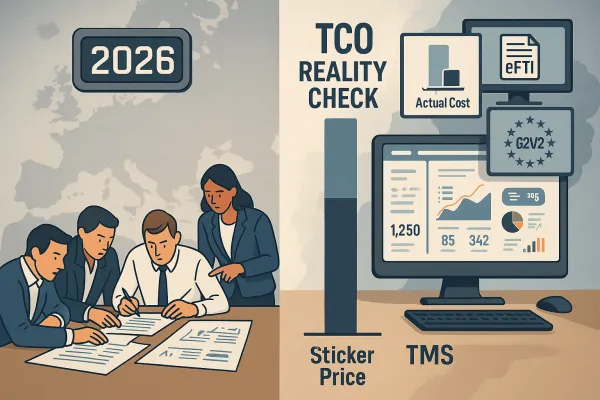
Hidden costs in TMS procurement consistently add 25-30% more than initial estimates, turning what looked like smart investments into budget disasters. Proper vendor stability assessment prevents these disasters by identifying risks before contracts are signed, when leverage remains strongest for negotiating protection clauses.
The manufacturer's approach demonstrates that systematic vendor stability assessment transforms procurement from reactive feature comparison into strategic risk management. In 2026's consolidating market, this proactive approach separates successful implementations from expensive disasters.