
TMS Vendor Stability Assessment: The European Procurement Scorecard That Prevents €800K Implementation Disasters During 2026's Historic Consolidation Wave

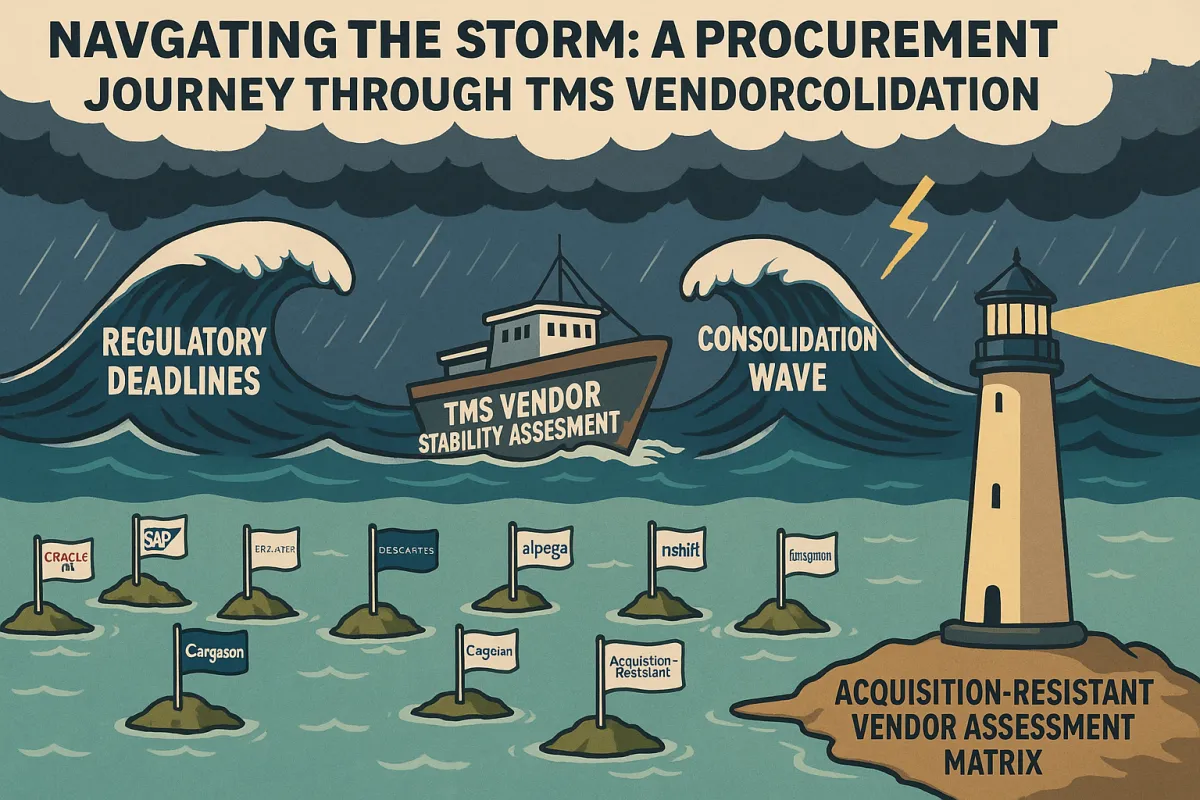
A German automotive manufacturer recently learned an expensive lesson about vendor stability assessment when their TMS provider introduced eFTI compliance as a premium add-on module nine months later, the additional licensing costs reached €800,000 annually. This happened after WiseTech Global's $2.1 billion acquisition of E2open and Descartes' purchase of 3GTMS for $115 million reshaped the vendor landscape while European shippers face mandatory compliance with eFTI Regulation by July 9, 2027, when Member State authorities must accept information shared electronically by operators via certified eFTI platforms.
The perfect storm isn't theoretical. European shippers face a sobering reality: 66% of technology projects end in partial or total failure, and now you're forced to navigate TMS vendor consolidation while meeting 2026's regulatory deadlines. When procurement teams fail to assess vendor stability properly during market consolidation, they inherit integration risks without managing the project directly.
The €800K Implementation Reality: Why Traditional Vendor Evaluation Fails in Consolidation Markets
Traditional TMS vendor evaluation frameworks weren't built for consolidation scenarios. Most procurement teams evaluate functionality, pricing, and basic financial health—missing the acquisition risk indicators that determine long-term stability. Companies undergoing integration often experience 12-18 months of reduced innovation while they harmonize platforms and teams.
The German manufacturer's experience reveals what happens when procurement overlooks consolidation risks. They signed a three-year renewal in early 2024 without regulatory compliance pricing protection. When their vendor introduced eFTI compliance as a premium add-on module nine months later, the additional licensing costs reached €800,000 annually. The vendor leveraged regulatory urgency to introduce premium pricing after the contract was signed.
The Perfect Storm: Consolidation + Regulatory Deadlines
European transport faces its most significant regulatory convergence in decades. By July 9, 2027, the eFTI Regulation will apply in full, requiring Member State authorities to accept information shared electronically by operators via certified eFTI platforms. This coincides with the new version (v3) of ICS2 messages on February 3, 2026, and decommissioning of older version (v2).
The consolidation timeline creates urgency. WiseTech Global's acquisition of E2open for $2.1 billion represents the largest transaction in logistics software history, while Descartes' 32nd acquisition since 2016 indicates this trend continues accelerating. Your procurement team should evaluate the full vendor landscape now while options remain available.
Companies that delay face diminishing choices. Companies that haven't initiated TMS selection processes by mid-2026 will find significantly fewer viable options as consolidation eliminates redundant platforms while regulatory deadlines remain immovable.
The Acquisition-Resistant Vendor Assessment Matrix [DOWNLOADABLE SCORECARD]
Smart procurement requires evaluating vendors across five critical stability dimensions: financial indicators, ownership structure, market positioning, regulatory readiness, and integration complexity. The post-consolidation landscape reveals three distinct categories: global mega-vendors (Oracle TM, SAP TM, E2open/WiseTech, Descartes), European specialists (Alpega, nShift, Transporeon), and emerging European-native solutions like Cargoson that maintain development focus specifically on European regulatory requirements.
Your assessment framework should address post-acquisition stability risks directly. When evaluating consolidated vendors, ask: How will product roadmaps merge? What's the timeline for platform standardization? Companies with unclear integration timelines create implementation risks for customers.
Financial Stability Indicators That Actually Predict Acquisition Risk
Revenue concentration and debt levels predict acquisition vulnerability better than traditional financial metrics. Vendors with declining market share or heavy private equity ownership face higher acquisition probability than established market leaders. E2open's $160M cash reserves and strong free cash flow ($33M in Q1 2024) couldn't prevent acquisition when market dynamics shifted.
Evaluate R&D investment patterns during your due diligence process. Companies reducing development spending or consolidating development teams signal potential acquisition targets. Platform evaluation should include established players like E2open (now part of WiseTech), Descartes, Oracle TM, and SAP TM alongside European specialists like Alpega, Transporeon, and modern alternatives including Cargoson.
Market positioning analysis reveals acquisition timing patterns. For e2open customers, the main concern is whether WiseTech will maintain innovation and product investment during the integration. For WiseTech clients, the acquisition offers access to broader supply chain capabilities but also brings uncertainty about future product directions and support.
European Regulatory Compliance as Vendor Selection Criteria
Regulatory compliance capabilities separate stable vendors from acquisition targets during market transitions. Electronic freight transport information could save the EU transport and logistics sector up to €1 billion per year by creating common standards and making systems work together.
Structure your evaluation around compliance readiness rather than traditional feature checklists. Vendors confident in their regulatory capabilities include compliance costs in base pricing rather than introducing premium add-ons post-contract. The use of eFTI platforms is expected to save the EU transport and logistics sector €1 billion annually by enabling real-time data sharing, improving logistics planning, and strengthening multimodal transport coordination.
Assess vendor development focus during consolidation uncertainty. Cargoson, Alpega, and other European specialists maintain development resources focused exclusively on European market needs, while global vendors like Descartes or WiseTech spread development efforts across multiple geographic priorities. This focus translates into faster feature development for European-specific requirements.
The 2026-2027 Regulatory Compliance Checklist
Eight critical compliance deadlines require vendor preparation:
- February 2026: ICS2 v3 implementation
- January 2026: CBAM financial obligations begin
- July 2026: Smart tachograph Gen2V2 mandatory for commercial vehicles
- January 2027: eFTI platform certification requirements
- July 2027: Full eFTI compliance mandatory
From July 2027, electronic freight data will be mandatory across the EU, marking the end of the paper era. The industry expects the transition to accelerate rapidly throughout 2026. Your vendor selection timeline must account for these immovable deadlines while vendor options remain available.
Contract Protection Clauses for the Consolidation Era
Standard TMS contracts rarely address vendor acquisition scenarios, leaving shippers exposed to post-acquisition service degradation and pricing changes. Build regulatory deadlines directly into implementation timelines with specific penalty clauses for vendor non-compliance.
Include acquisition notification requirements in your vendor contracts. Require 12-18 months advance notice of ownership changes, 24-month pricing protection periods, functionality guarantee clauses, and migration assistance provisions. Quarter-end and year-end deadlines provide natural leverage opportunities, while regulatory deadline pressure creates additional urgency that benefits prepared buyers.
Performance Guarantees That Survive Acquisitions
Structure performance guarantees around regulatory compliance rather than general functionality metrics. Include financial penalties for missed eFTI compliance deadlines and guaranteed functionality preservation periods that survive ownership changes.
Protect against integration disruptions during vendor transitions by requiring dedicated customer success resources during ownership transition periods. The window for optimal TMS contract negotiations closes rapidly as vendor options diminish and regulatory requirements become mandatory. European shippers who act decisively in 2026 secure favorable contract terms and compliance-ready platforms.
The 90-Day Procurement Action Plan
Your procurement window runs through Q1 2026, providing 3-4 months of leverage before vendor capacity tightens and regulatory urgency intensifies. European shippers who act decisively within the next 90 days—with proper frameworks that account for both capacity and consolidation scenarios—position themselves to navigate 2026's perfect storm successfully.
Days 1-30: Complete financial stability assessment and acquisition risk analysis. Review vendor financial statements, ownership structure, and market positioning. Identify potential acquirers by analyzing which larger players lack capabilities in your vendor's specialization areas.
Days 31-60: Execute proof-of-concept testing with shortlisted vendors while evaluating regulatory compliance capabilities. Your procurement team should evaluate the full vendor landscape including established platforms like MercuryGate, Descartes, E2open, Manhattan Active, Oracle TM, and SAP TM alongside European specialists like Alpega, nShift, Transporeon, and modern alternatives including Cargoson that focus specifically on European cross-border operations.
Days 61-90: Negotiate acquisition-resistant contract terms with regulatory compliance guarantees. Include acquisition notification requirements, price protection clauses, functionality guarantees, and termination rights while leveraging competitive dynamics between remaining independent vendors.
The consolidation wave creates both risk and opportunity for prepared procurement teams. Companies that complete vendor stability assessments and secure acquisition-resistant contracts before mid-2026 position themselves to navigate regulatory transitions successfully while competitors scramble with fewer options and higher costs.