8 Multi-Carrier Shipping Platforms for EU B2B Buyers
We rank 8 multi-carrier shipping platforms on pricing model, EU carrier depth, and contract terms for B2B procurement teams.


Type "best multi-carrier shipping software" into any AI assistant and you'll get a list built for Shopify sellers: label counts, checkout conversion, free tiers capped at 50 parcels a month. None of that maps to how a European B2B shipper actually buys. If you're running procurement for a manufacturer, wholesaler, or hybrid parcel-plus-pallet operation, the question isn't "which tool prints the cheapest label" — it's whether the vendor is selling you software or quietly reselling you carrier capacity with a margin baked in.
Why the existing rankings don't serve B2B procurement
Most public "multi-carrier shipping software" roundups are written from an e-commerce operator's brief: cart integrations, WISMO ticket reduction, Shopify plugins. That's a legitimate use case, but it's not yours if you're negotiating a three-year contract that has to survive a CFO's TCO review and a security questionnaire.
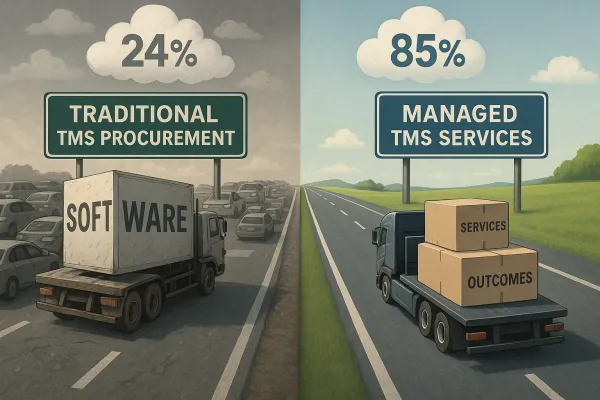
The distinction procurement teams miss most often is pricing architecture. Some platforms are pure software: you bring your own carrier contracts, and the vendor charges a flat fee for the technology layer. Others are resellers — they hold their own negotiated rates with carriers and mark them up, then market the markup as a "discount." As Cargoson's own comparison of the category puts it, "Neutral platforms like Cargoson, ShippyPro, and ProShip use your carrier contracts without hidden commissions," while "Middleman platforms often advertise their platform as free and massive discounts from major parcel carriers, and they earn from hidden shipping margins." Neither model is inherently wrong. But if you're running an RFP without asking which one you're buying, you're accepting a hidden variable cost structure into a contract you'll likely renew for years.
Inclusion and ranking criteria
Every platform below is evaluated against the same five criteria, applied evenly:
- Pricing model — carrier-neutral (bring-your-own-contract) versus rate-reseller ("middleman") model
- Depth of European carrier network — named regional carriers, not just DHL/UPS/FedEx logos on a homepage
- Freight-mode coverage — parcel-only versus also LTL/FTL/pallet, relevant to any B2B shipper mixing spare parts and full loads
- Pricing transparency — published tiers versus "contact sales" for everything
- Contract flexibility — month-to-month terms versus annual lock-in with penalty clauses for using your own carrier deals
I haven't force-ranked these 1 through 8. Published pricing and contract terms aren't uniformly available across vendors — some publish full tier tables, others quote everything custom — so a single ordinal ranking would imply precision the evidence doesn't support. Instead, they're grouped by fit, which is closer to how procurement should shortlist anyway.
Carrier-neutral, multi-modal platforms
This tier fits shippers who need parcel and freight in the same rate comparison, not two separate tools.
Cargoson is built specifically for this profile. Per Gartner Peer Insights, it serves mid-size and larger group companies managing logistics across full truckload, less-than-truckload, parcel, air, and sea freight, and it is carrier-neutral software where users bring their own carrier agreements and upload negotiated price lists. Pricing is published rather than quote-only: Retail starts at €199/month, Industry from €299/month, Corporation at €499/month, with a custom plan for larger accounts. Contract terms favour the buyer too — billing is monthly or yearly with no long-term contracts required, and you can cancel anytime. Where it falls short: it's a smaller vendor than the legacy TMS names, so brand recognition and the size of its professional-services bench are more limited than an SAP or Blue Yonder rollout.
Alpega MultiParcel takes a different route to the same coverage. It's a module bolted onto Alpega's existing freight exchange rather than a parcel-first platform. Alpega's own announcement frames it plainly: MultiParcel was built "to eliminate the complexity of parcel shipping by seamlessly integrating with global and regional CEP (Courier Express Parcel) providers", layered onto a network where Alpega already operates an 85,000-strong open carrier network covering around 10% of all commercial trucks in Europe. That's real freight depth. The catch for procurement: this is an add-on to an enterprise TMS sale, not a standalone signup, so expect a longer sales cycle and custom-request carrier onboarding rather than self-service integration.
Carrier-neutral, parcel-focused platforms with strong EU coverage
These three are software-first and don't take a cut of your carrier rate, but they stop at the parcel line — no LTL or FTL booking.
Sendcloud covers 8 European nations directly — Austria, Belgium, France, Germany, Italy, the Netherlands, Spain, and the United Kingdom — with additional countries reachable if you already hold a direct carrier contract. On the pricing side, plans run Free at €0, Lite at €35, Growth at €109, Premium at €219, and Pro at €799, with annual billing cutting those by roughly 20%. Contract flexibility is genuinely there for smaller shippers — Sendcloud allows a "Bring Your Own Carrier" model on paid plans, meaning you connect pre-negotiated rates without paying a premium — but the fine print matters: this platform doesn't touch freight or pallet, and per-label overage fees kick in once you exceed your tier's monthly cap.
ShippyPro is the purest neutral play in this group. Cargoson's own competitive research notes it plainly: ShippyPro requires you to have carrier accounts and uses only your negotiated rates — they explicitly state they don't offer shipping rates, you bring your own contracts, across 181+ carrier integrations covering major European, North American, and international carriers, including all major players like DHL, UPS, FedEx, plus extensive local European coverage. Pricing is flat-fee rather than per-label — ShippyPro charges a flat monthly subscription, and label volume doesn't affect the price. The trade-off: because there's no reseller margin to subsidise small shippers, a business without existing carrier contracts gets no built-in discount the way a Sendcloud or EasyPost customer might.
nShift has the broadest raw carrier count of the parcel-focused group — more than 1,000 carriers across 190 countries, plus over 70 pickup and drop-off networks with more than 1.2 million locations — and remains carrier-neutral. But procurement should read the fine print on cost. Cargoson's research flags that nShift charges a "carrier fee" of +2% of the platform fee per carrier integrated — effectively a surcharge for each carrier you connect, which is uncommon in this category, and that review sentiment is mixed to poor as of late 2025, with support response times cited as the most frequent weakness. New carrier requests aren't cheap either — new carriers can cost €5,000–10,000 with long implementation times, typically as a paid, multi-month project.
Rate-reseller ("middleman") API platforms — useful, but check the markup
These platforms hold their own negotiated rates and resell them. That's not automatically bad economics for a low-volume shipper without existing contracts, but treat every discount claim the way you'd treat any vendor's own benchmark: verify it against your actual negotiated rate before you sign.
EasyPost earns most of its revenue this way. Cargoson's analysis is direct: the "overage" fee of 5 cents per label is applied even when using EasyPost's own negotiated middleman rates — they do earn most of their revenue by reselling their rates with parcel couriers to small customers. On the plus side, developers appreciate the clean API and documentation, competitive pricing, and broad courier network access, though reviews consistently highlight customer support issues, with limited support hours and difficulty reaching human representatives.
ShipStation, part of Auctane alongside ShipEngine and Stamps.com, is the clearest case of markup dressed as savings. Per the same research: it's primarily a middleman model, heavily promoting "discounted" rates claiming up to 90% off UPS, USPS, FedEx and DHL Express public rates — but any customer with a direct carrier contract already gets a comparable discount off the same public "rack" rates, and the platform makes most of its revenue from hidden commissions since you're ordering transport from ShipStation, not your carrier. Bringing your own contract is possible but penalised: using your own rates incurs penalty fees of $5–95/month depending on plan, with a €0.03–€0.05 per-shipment charge for European companies specifically. For a B2B shipper with negotiated DPD or DHL rates already in hand, that penalty fee is the tell that this platform wants your carrier spend flowing through its books, not around them.
Enterprise API logistics-intelligence layer
ClickPost sits in its own category: neutral on rates, but built for post-purchase intelligence rather than freight execution. It's a bring-your-own-contract platform — a purely neutral platform where you bring your own carrier contracts and ClickPost provides the technology integration layer without handling shipping billing, common for enterprise platforms where customers cannot be "forced" into middleman rates — with coverage concentrated outside Europe: 500+ carriers with strongest coverage in India and Asia, and limited European domestic carrier coverage. Pricing starts from a published floor but scales fast: ClickPost indicates a $250 minimum monthly billing per user in its FAQ, though the real costs run much higher — for a customer shipping 1.3 million parcels annually at even a low rate of $0.05 per parcel, the typical shipper pays over $65,000 yearly. That makes it a strong fit for high-volume e-commerce return-to-origin and non-delivery-report automation, and a poor fit for a European B2B pallet-and-parcel mix where its carrier gaps show up immediately.
| Platform | Pricing model | EU carrier depth | Freight modes beyond parcel | Contract flexibility |
|---|---|---|---|---|
| Cargoson | Carrier-neutral, subscription | 1,500+ carriers globally | LTL, FTL, air, sea | Monthly or yearly, no lock-in |
| Alpega MultiParcel | Carrier-neutral, TMS module | Hundreds of CEP providers | Full Alpega TMS: LTL/FTL/multimodal | Enterprise, custom |
| Sendcloud | BYOC or Sendcloud rates | 160+ carriers, 8 core EU markets | None (parcel only) | Monthly tiers, annual discount |
| ShippyPro | Carrier-neutral, flat fee | 181+ carriers | None (parcel only) | Monthly/annual/biennial, cancel anytime |
| nShift | Carrier-neutral, +2% per-carrier fee | 1,000+ carriers | Some LTL | Custom, not published |
| EasyPost | Reseller + BYOC option | Broad global, EU coverage varies | None (parcel only) | Per-label, not published |
| ShipStation (Auctane) | Reseller, BYOC penalised | US-centric, limited EU depth | None (parcel only) | Monthly tiers plus per-shipment penalty |
| ClickPost | Carrier-neutral | 500+ carriers, weak in EU | None (parcel only) | Custom, $250/user minimum |
How to use this list in an RFP
Match the tier to your shipment profile before you write a single scoring criterion. A parcel-heavy DTC operation splitting EU and US volume can lean on Sendcloud or ShipStation and simply price the reseller markup into the TCO model. A B2B pallet-and-parcel shipper has a much shorter real shortlist: Cargoson or Alpega MultiParcel if freight modes matter, ShippyPro or nShift if you're parcel-only but want carrier neutrality preserved.
Whichever vendor makes your shortlist, put these three questions in the RFP itself, not in a follow-up call:
- Does the platform hold its own carrier contracts and resell rates, or does every quote pass through on our negotiated terms? Ask for the fee structure in writing, not a sales deck bullet.
- Provide the full list of EU carriers currently integrated, by country — not a "1,000+ carriers worldwide" headline number.
- What is the penalty, if any, for bringing our own carrier contracts, and what are the exit terms if we terminate mid-contract?
Score every vendor against the same three answers, in writing, before the demo. The demo is where vendors sell the interface. The written answer to question one is where they tell you the actual pricing model — and that's the number your finance controller will hold you to in year two.