
Beyond Build vs Buy: The 3-Path TMS Procurement Framework European Shippers Need to Navigate Managed Services, Vendor Consolidation, and €800K Implementation Disasters

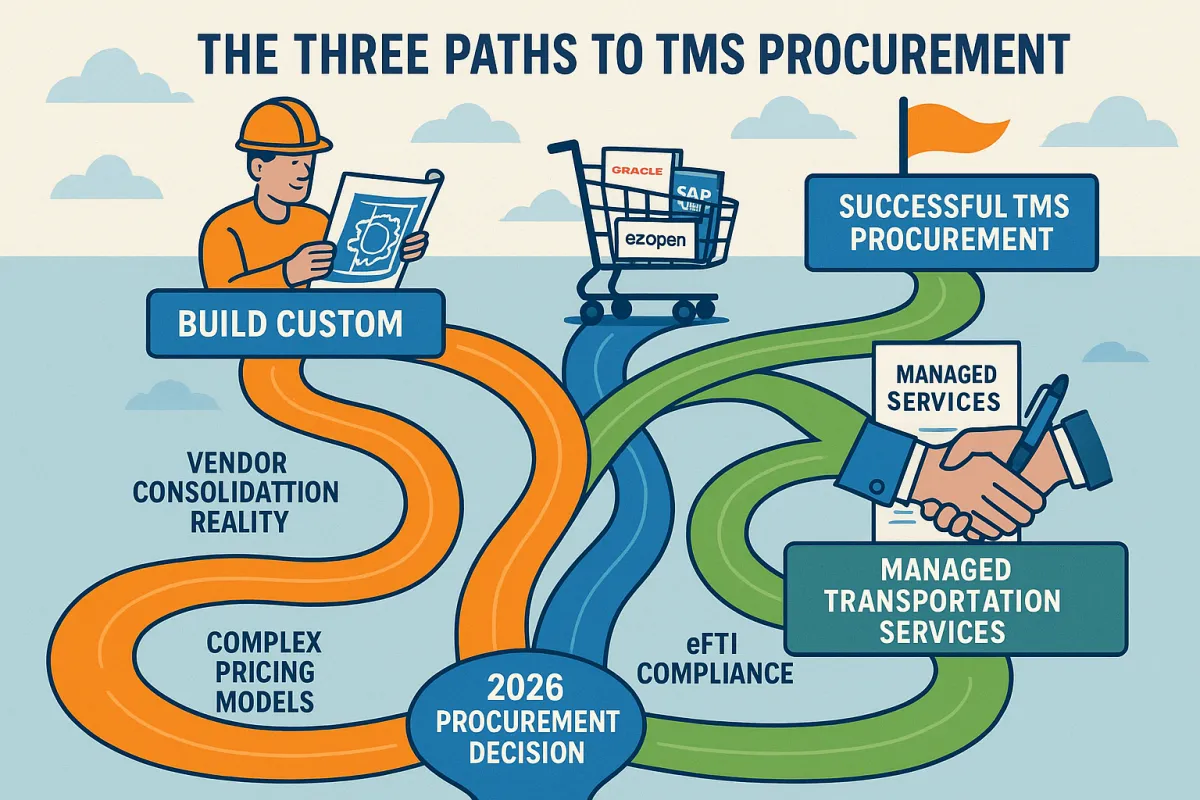
European procurement teams navigating TMS decisions in 2026 face more than the traditional "build versus buy" dilemma. The numbers paint a bleak picture: seventy-six percent of logistics transformations never fully succeed, failing to meet critical budget, timeline or key performance indicator (KPI) metrics, while WiseTech's $2.1 billion acquisition of E2open and Descartes' purchase of 3GTMS for $115 million signal unprecedented vendor consolidation. You're not just choosing between building custom software or purchasing an existing platform anymore—managed transportation services have emerged as a third path that outsources operations entirely rather than simply providing software tools.
The Death of Simple Build vs Buy: Why 2026 Demands a Three-Path Framework
Traditional build-versus-buy frameworks collapse under 2026's complexity. European shippers face a sobering reality: 66% of technology projects end in partial or total failure, while 17% of large IT projects go so badly, they threaten the very existence of the company. Meanwhile, eFTI Regulation will apply in full from 9 July 2027, with Member State authorities required to accept electronic data when shared by businesses via eFTI-compliant platforms.
Vendor consolidation adds another layer of procurement risk. Companies undergoing integration often experience 12-18 months of reduced innovation while they harmonize platforms and teams. Post-acquisition integration timelines typically span 12-18 months, during which platform development stagnates and support quality deteriorates. Oracle, SAP TM, E2open (now part of WiseTech), MercuryGate (now Infios), and emerging European solutions like Cargoson navigate this shifting landscape with fundamentally different risk profiles.
Path 1 - Build Custom: When Transportation Software Becomes Competitive Advantage
Custom TMS development makes sense when transportation represents genuine competitive differentiation rather than operational necessity. Consider a European manufacturer with proprietary routing algorithms that reduce cross-border transit times by 15-20%, or specialized workflows that standard platforms simply cannot accommodate.
The financial reality requires honest evaluation. The license is typically only about 20–25% of total cost; the rest hides in integration, add-on modules, and disruption. Plan for 8–12 months to implement properly—not the "weeks" you'll hear in sales calls. European data residency requirements under GDPR add complexity that American-developed platforms often handle as afterthoughts.
Development timelines stretch longer than anticipated. As of January 2026, eFTI platforms and service providers can start preparing for operations while Member States authorities may start accepting data stored on certified eFTI platforms for inspection. Custom builds must incorporate these compliance requirements from day one, not as future enhancements.
Path 2 - Buy Traditional TMS: The Vendor Consolidation Reality Check
E2open creates strategically significant change in global scale and reach for WiseTech, adding adjacent markets, customer bases, and product capabilities. The deal is supply chain, global trade management and direct importer, exporter, shipper centric, with little overlap between the WiseTech and e2open's largely complementary customers, products and markets.
Traditional TMS procurement faces pricing model complexity beyond licensing fees. Purchase price is only ~20% of TCO. "The 'sticker price' of a TMS is often only 20% to 25% of its total cost of ownership." Oracle TM, SAP TM, and Blue Yonder compete alongside European options like Alpega, Cargoson, and nShift, each requiring different integration approaches and offering varying regulatory compliance capabilities.
The European TMS market, valued at €1.4 billion in 2024 and growing at a compound annual growth rate of 12.2 percent, is forecasted to reach €2.5 billion by 2029. This growth occurs alongside consolidation that's eliminating procurement options faster than most teams anticipate.
Path 3 - Managed Transportation Services: Operational Outsourcing vs Software Tools
Managed transportation services and a transportation management system (TMS) solve the same problem — running freight more efficiently — but through opposite approaches. A TMS gives your logistics team software to automate tendering, tracking, and reporting. Managed transportation replaces what your logistics team does, providing the technology, the carrier network, and the people to run your freight program. The right choice depends on whether you want to operate freight better or stop operating freight altogether.
Implementation timelines differ dramatically. In a well-structured managed TMS arrangement, the logistics provider handles the day-to-day operation of the platform, including carrier management, load planning and optimization, shipment execution, tracking, exception management, freight audit, payment, and reporting. The shipper retains strategic control over their transportation program, including carrier selection criteria, service level requirements, budget targets, and network design decisions, while the managed provider handles the tactical execution.
Managed transportation makes sense when your company: Ships 100–500 loads per month with a small logistics team (1–5 people) Has evaluated a TMS but cannot justify the implementation timeline, capital cost, or internal headcount to run it · Currently manages freight through multiple brokers with inconsistent visibility and performance data · Needs operational improvement faster than a TMS implementation allows
The European Procurement Decision Matrix: Evaluating All Three Paths
Your evaluation framework must weight five dimensions: time-to-value, internal control requirements, staff capacity, competitive differentiation needs, and regulatory compliance capability. As of January 2026, eFTI platforms and service providers can start preparing for operations while Member States authorities may start accepting data stored on certified eFTI platforms for inspection. This creates the first practical deadline for demonstrating compliance capability across all three paths.
European regulatory requirements function as decision filters. It could save the EU transport and logistics sector up to €1 billion per year through digital transformation, but only for organizations that implement properly before mandatory deadlines. Companies that delay face reduced vendor choice and increased implementation timelines as 2027 approaches.
Build custom solutions when transportation creates competitive advantage that justifies multi-year development timelines. Buy traditional TMS platforms when you need comprehensive functionality with acceptable implementation complexity. Choose managed transportation services when operational improvement matters more than technology ownership.
TCO Modeling for All Three Approaches
Implementation fees are the starting point, not the total. Add: internal project management time (often 0.5–1 FTE for 12+ months), data migration, carrier onboarding, staff training, and IT maintenance post-go-live. Industry analysts estimate total cost of ownership for a mid-market TMS at 2–3x the quoted software price over a 3-year period. Managed transportation converts that capital investment and overhead into a predictable operating expense — and eliminates the staffing requirement to run the system.
Factor in consolidation risks. Plan for 15-20% budget increases in 2026-2027 if reactive, or 8-12% if proactive with proper contract protection. Custom builds avoid vendor risk but require internal maintenance indefinitely. Traditional TMS purchases expose you to acquisition uncertainty while managed services transfer operational risk to your provider.
Five-year cost modeling should include licensing (20-30% for traditional TMS), implementation (25-40%), carrier integration (15-25%), and ongoing support (10-15%). Managed transportation typically costs 1-3% of freight spend plus technology fees but eliminates most internal resource requirements.
Contract Protection Strategies for Vendor Consolidation Era
Acquisition-resistant contract clauses become mandatory in 2026's consolidating market. Include 24-month pricing locks, 90-day advance notice requirements for platform changes, and functionality preservation guarantees. When evaluating consolidated vendors or acquisition targets, include contract language requiring vendor disclosure of platform integration timelines, feature deprecation schedules, and customer migration support. When two TMS platforms merge, customers inevitably face decisions about which system to standardize on, what features will be deprecated, and how long dual support will continue.
Vendors claiming eFTI readiness should demonstrate functional integration by January 2026, not just promise compliance by the July 2027 mandate. Baseline eFTI requirements should be contractually protected against upgrade costs, while optional enhancements remain negotiable.
Build contracts that protect against post-acquisition platform consolidation. Specify that core European functionality cannot be deprecated without 18-month notice and alternative solution provision. Oracle, SAP, MercuryGate, Descartes, and regional providers like Cargoson each approach European compliance differently—your contracts should reflect these differences.
Implementation Risk Management Across All Paths
The numbers paint a bleak picture: seventy-six percent of logistics transformations never fully succeed, failing to meet critical budget, timeline or key performance indicator (KPI) metrics, with integration friction as the primary failure driver. Realistic timelines require 8-12 months for proper TMS implementation regardless of vendor promises during sales cycles.
Custom builds require the longest timelines but offer the most control over European compliance implementation. Traditional TMS purchases depend heavily on vendor European expertise—Oracle and SAP often struggle with localized requirements while European specialists like Alpega and Cargoson typically handle cross-border complexity more effectively.
Managed transportation services offer the fastest time-to-value but require careful provider evaluation. Your managed provider's technology must handle eFTI compliance, cross-border documentation, and European carrier connectivity without passing integration complexity back to your team.
The three-path framework acknowledges that 2026's convergence of regulatory deadlines and vendor consolidation creates fundamentally different procurement requirements than traditional build-versus-buy decisions. European shippers who act decisively—whether building custom solutions, purchasing traditional platforms, or outsourcing to managed providers—secure better terms and compliance-ready operations before market consolidation limits their options.