EU AI Act TMS Compliance Crisis: The European Procurement Framework That Prevents €3M+ AI Regulatory Violations While Navigating 2026's High-Risk System Classification Chaos

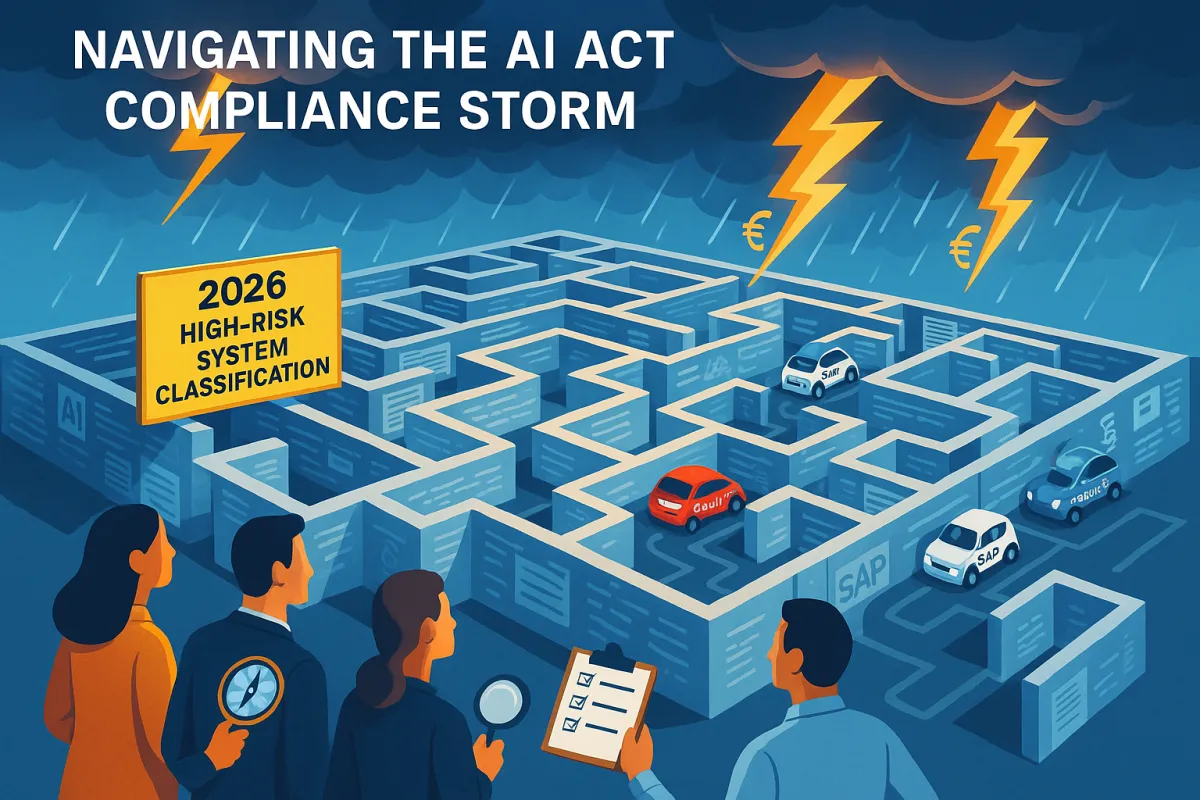
European transport buyers face a perfect storm. Non-compliance with certain AI practices can result in fines up to 35 million EUR or 7% of a company's annual turnover, while other violations can result in fines up to 15 million EUR or 3% of a company's annual turnover. The rules for high-risk AI will come into effect in August 2026, creating a seven-month window for procurement teams to establish compliant transport management software (TMS) frameworks.
The scope reaches beyond obvious AI applications. AI managing energy, transport, and utilities where failure could endanger lives falls under high-risk classification. This means TMS platforms controlling automated warehouse operations, optimizing critical supply chain decisions, or managing cross-border logistics now trigger the Act's most stringent obligations.
What most procurement teams miss: From 2026, the EU Artificial Intelligence Act will come into full effect for logistics companies, requiring high-risk AI systems to meet specific compliance standards that your current vendor evaluation process wasn't designed to handle. The financial exposure alone justifies immediate action.
The High-Risk TMS Classification Reality Check
Transportation Systems: Autonomous vehicles and AI-driven traffic management systems represent the obvious candidates, but European shippers need a broader understanding. Any TMS using AI for route optimization affecting worker safety, automated inventory decisions impacting supply chain continuity, or dynamic pricing algorithms influencing contract negotiations potentially qualifies.
The classification triggers when AI systems are classified as high-risk if its intended use falls into any Annex III sector and it poses a significant risk. Transport management systems controlling critical infrastructure like automated warehouses or cross-border customs clearance workflows meet both criteria.
AI systems used to manage critical infrastructure, like energy grids or transportation systems, Transportation: AI applications in autonomous driving or traffic management systems establish clear precedent. But procurement teams often overlook how modern TMS platforms integrate these functions into supposedly "basic" logistics workflows.
Consider Oracle Transportation Management, SAP Transportation Management, Manhattan Associates, Descartes, MercuryGate, BluJay, Transporeon, nShift, and Cargoson. Each provider handles AI classification differently, with some treating predictive analytics as low-risk enhancements while others acknowledge their route optimization and demand forecasting capabilities trigger high-risk obligations.
Why Standard Vendor Questionnaires Fail Under AI Act Requirements
Traditional RFP approaches cannot capture AI Act compliance obligations. Until 2 August 2026, we recommend classifying all AI systems, assessing whether they fall under High-risk or prohibited categories becomes a legal requirement, not a vendor preference.
Your procurement team needs detailed documentation of every AI component within candidate systems. The technical documentation, risk assessments, testing records, and data governance materials the Act requires exceed what most organizations maintain for traditional software. Building these capabilities takes time—retrofitting documentation for existing systems is exponentially more difficult than building compliance from selection.
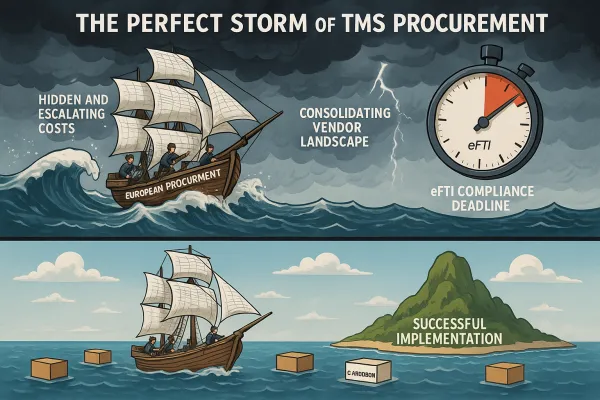
The vendor consolidation wave compounds this challenge. WiseTech Global's $2.1 billion acquisition of E2open and Descartes Systems Group's $115 million purchase of 3GTMS in March 2025 represent the most significant TMS vendor consolidation wave in over a decade, reducing compliance alternatives while increasing implementation urgency.
The AI Act-Compliant TMS Procurement Framework
Organizations starting today barely have enough time for August 2026. Conformity assessment alone takes 6-12 months. European procurement teams need structured approaches that address both technical compliance and commercial protection.
Step 1: AI System Inventory and Classification
Document every AI component in shortlisted platforms. Route optimization algorithms, demand forecasting models, carrier selection engines, and dynamic pricing tools all require individual assessment. Any AI system used for profiling natural persons—automated evaluation or prediction of individuals' traits, preferences, or behaviour—is automatically classified as high-risk. Even when a provider believes a system does not pose serious risks, its profiling function alone triggers this classification.
Your vendor evaluation must distinguish between AI systems that enhance human decision-making versus those that execute autonomous actions. Systems that automatically reroute shipments during disruptions or adjust inventory allocation without human intervention create higher compliance obligations than advisory dashboards.
Step 2: Vendor AI Compliance Assessment
Evaluate Oracle TM, SAP TM, Manhattan WMS, Descartes, Blue Yonder, MercuryGate, Transporeon, nShift, and Cargoson against specific compliance criteria. Companies providing high-risk AI systems must follow certain rules. They must make sure their AI systems meet specific standards and display their contact information on the product or its packaging. They need to have a quality management system and keep certain documents and logs.
Request conformity assessment documentation, CE marking evidence, and post-market monitoring procedures. Providers must demonstrate continuous compliance throughout your contract term, not just initial deployment. Before selling or using the AI system, they must have it checked for compliance with regulations. They also need to mark the product with a CE marking to show it meets EU standards.
Step 3: Integration with Regulatory Timeline Management
Your TMS selection timeline must accommodate Start with core functionality in Q2-Q3 2025, activate AI features in Q4 2025, and ensure eFTI compliance by Q1 2026. The convergence of multiple regulatory deadlines creates implementation bottlenecks that affect vendor resources and project timelines.
European shippers must navigate ICS2 customs requirements, EU ETS emissions reporting, and country-specific digital documentation standards. Failure to comply with the regulations can result in severe penalties, which in some countries can reach up to 30,000 euros. Your TMS procurement must address these integrated compliance requirements rather than treating AI Act obligations in isolation.
Contract Terms That Actually Protect Against AI Violations
Standard TMS contracts lack AI Act-specific protection mechanisms. Include liability allocation clauses that address fines up to 35 million EUR or 7% of a company's annual turnover, Other violations can result in fines up to 15 million EUR or 3% of a company's annual turnover. Your agreement must specify vendor responsibility for maintaining compliance documentation and managing regulatory updates.
Performance guarantees should include transparency requirements, human oversight mechanisms, and incident reporting procedures. Providers of high-risk AI systems must implement continuous monitoring programs, track system performance in real-world conditions, report serious incidents to authorities within strict timeframes. Contract terms must require vendors to maintain these capabilities throughout your agreement term.
Include exit clauses triggered by non-compliance events. Misclassification of AI systems as High-risk or prohibited practices may lead to mandatory recalls, suspension of deployment, or restrictions on market access. Your commercial agreements need provisions for system replacement or modification when compliance obligations change.
Vendor Competitive Analysis for AI Act Readiness
Established providers like Oracle Transportation Management and SAP TM benefit from enterprise compliance resources but face legacy system constraints. Their AI Act preparation focuses on retrofitting existing platforms rather than native compliance architecture.
Mid-market leaders including Descartes, MercuryGate, and Blue Yonder demonstrate mixed approaches. Some providers treat AI features as optional enhancements while others recognize that embedded optimization algorithms trigger high-risk classification regardless of user interaction levels.
European specialists like Transporeon, Alpega, nShift, and Cargoson often provide clearer AI Act positioning due to regional regulatory focus. However, smaller providers may lack resources for comprehensive conformity assessment procedures required under the Act.
Integration Strategy: AI Act + eFTI + ERP Compliance Convergence
Your procurement strategy must address regulatory convergence rather than individual compliance requirements. These regulatory requirements multiply TMS implementation costs through mandatory integrations with government systems, telematics providers, and customs platforms. Traditional TCO models that focus on basic functionality miss these compliance-driven expenses.
ERP integration costs exceed €50,000 for complex connections, while seventy-six percent of logistics transformations never fully succeed, failing to meet critical budget, timeline or key performance indicator (KPI) metrics. The window for strategic procurement decisions narrows as regulatory deadlines converge and vendor consolidation limits implementation resources.
European shippers who act strategically within the next 90 days can secure voice AI implementations before 2026's regulatory deadlines and capacity constraints eliminate flexibility. The same urgency applies to AI Act-compliant TMS procurement: delays beyond Q1 2026 will face reduced vendor availability, higher implementation costs, and compressed compliance timelines.
Your strategic decision framework should prioritize providers with demonstrated AI Act readiness, integrated compliance capabilities, and flexible implementation approaches that accommodate regulatory convergence requirements rather than treating each obligation separately.