
TMS Cloud Migration Security Gap: The European Risk Assessment Framework That Prevents the 77% Identity Crisis While Navigating Shared Responsibility Blind Spots

A mid-sized automotive parts distributor in Stuttgart discovered the hard way why 80% of organizations will face cloud data breaches in 2026 due to identity drifts, with 70% of organizations rating identity and access management as their top risk. Six months into their cloud TMS migration, their security incidents climbed with the 154% year-over-year surge in significant cloud breaches, as 61% of organizations reported major incidents in 2024 compared to 24% in 2023. The problem wasn't the cloud platform itself. The gap lay in understanding exactly where vendor responsibilities ended and theirs began.
The European TMS Cloud Migration Crisis: When 63% Jump Without Looking
European manufacturers are embracing cloud TMS solutions at unprecedented rates, with 63% choosing cloud deployment for the first time. Yet within six months of go-live, a disturbing pattern emerges. 99% of organizations that experienced cloud-related breaches blamed insecure identities as the primary cause, while 95% of cloud security failures still stem from misconfigurations due to human error, with 27% of organizations using public clouds facing security incidents in 2024.
Traditional TMS vendors like SAP TM and Oracle TM are struggling with this cloud transition, primarily because their solutions were designed for on-premise environments and retrofitted for cloud deployment. Modern cloud-native solutions like Cargoson, Descartes, and E2open have built their architectures specifically for cloud deployment, but even these require careful attention to the shared responsibility model.
The issue isn't technical capability—it's a fundamental misunderstanding of cloud security responsibilities. Cloud users must understand and practice their responsibility over the security measures in their control, protecting the sensitive data they put into cloud services.
The Shared Responsibility Blind Spot Costing Companies Millions
Here's the dangerous misconception: many procurement teams believe cloud providers handle all security aspects. A German automotive parts manufacturer faced €800,000 in additional costs when carrier integration failures emerged post-implementation. The root cause? They assumed their cloud TMS provider secured all data flows, including API connections to 47 different carriers across 12 European countries.
Baseline configuration, identity security, and access controls continue to dominate as effective controls in common and advanced breach cases. Yet Gartner predicts that 99% of cloud security failures will be the customers' fault. The shared responsibility model creates clear divisions: cloud providers secure infrastructure, networks, and physical facilities. Customers must secure applications, data, user access, and configurations.
This division becomes particularly complex for TMS deployments because transport management systems integrate with dozens of external systems—ERP platforms, carrier APIs, customs systems, and financial applications. Each integration point represents a potential vulnerability if not properly secured.
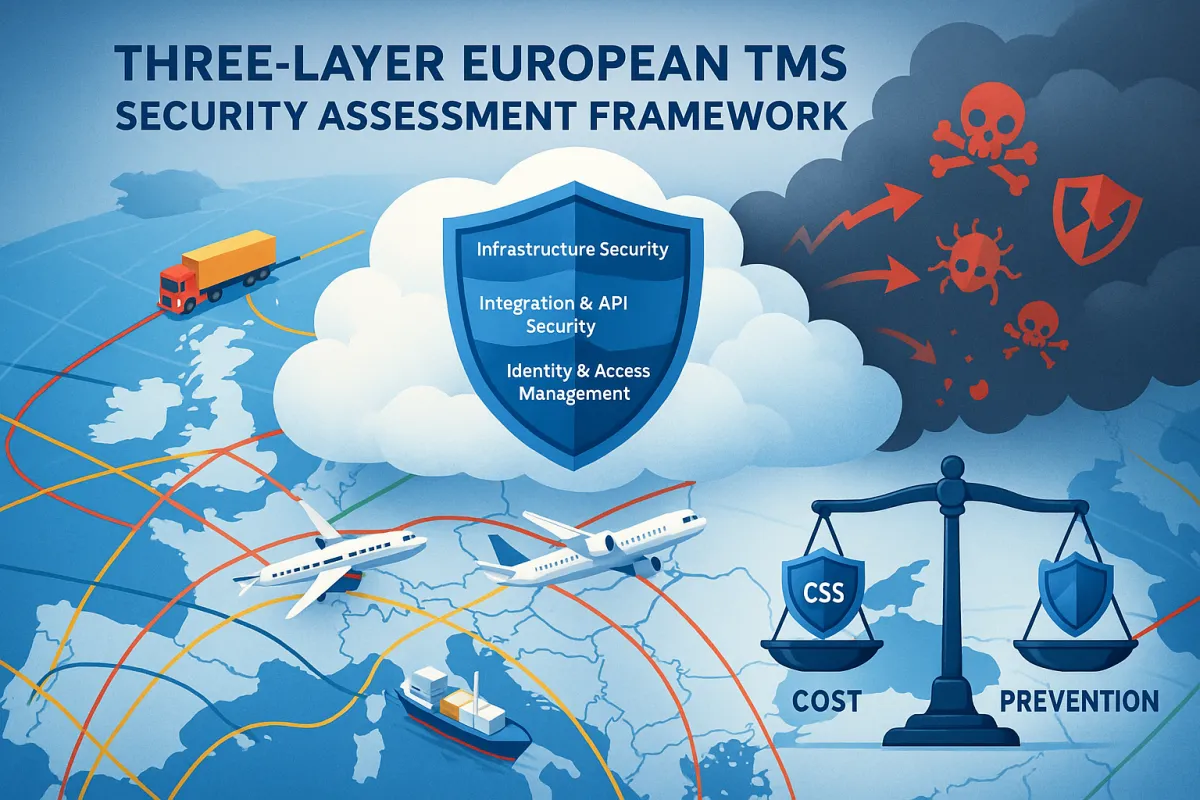
The Three-Layer European TMS Security Assessment Framework
Effective TMS cloud migration risk assessment requires evaluating security across three distinct layers, each with different responsibility allocations and risk profiles.
Infrastructure Security: What Your Cloud TMS Provider Actually Manages
Cloud providers handle server availability, physical security, and underlying infrastructure protection. This often includes robust data encryption, redundancy and disaster recovery protocols, with cloud providers investing heavily in security measures to protect data and ensure uptime. However, 95% of cloud security failures still stem from misconfigurations due to human error—not inherent platform vulnerabilities.
When evaluating vendors like Transporeon, nShift, or Alpega, assess their infrastructure security capabilities:
- Data residency compliance for European operations
- Encryption standards for data at rest and in transit
- Network segmentation and access controls
- Disaster recovery and business continuity procedures
- Security certifications (SOC 2, ISO 27001, GDPR compliance)
European freight operations span 27 regulatory frameworks, requiring specific data formats and handling procedures. Solutions like Cargoson, Blue Yonder, and FreightPOP have built European-specific capabilities, while traditional vendors often require extensive customization to meet local requirements.
Integration & API Security: The Gray Zone Where Most Failures Occur
APIs drive all modern cloud TMS processes, but insecure APIs allow attackers to infiltrate backend systems, alter data, and spread laterally across the environment. Data mapping complexity between TMS, ERP, and legacy systems creates the major failure point for European operations.
Consider a typical European shipper connecting their cloud TMS to 23 carriers, each with different API specifications, authentication methods, and data formats. Compromised identities account for over 70% of cloud breaches, with identity remaining the foundational security layer in cloud environments. Each carrier connection represents a potential identity management challenge.
The assessment framework for API security includes:
- Authentication protocols and credential management
- Data encryption for API communications
- Rate limiting and access controls
- Audit logging for all API interactions
- Error handling that doesn't expose sensitive information
Solutions like Cargoson and MercuryGate have invested heavily in secure API architectures, while vendors like Manhattan Active provide comprehensive API security frameworks designed for enterprise-scale integrations.
The European Compliance Security Matrix
DORA, NIS2 Directive, and the Data Act are reshaping how European businesses assess digital vendors, shifting focus from functional criteria to structural security guarantees. Regulatory requirements like the EU Data Governance Act demand cross-cloud logging and incident reporting discipline that traditional tools cannot deliver.
European freight operations face stricter data protection requirements than global counterparts. GDPR compliance alone isn't sufficient—sector-specific regulations impose additional controls, leading EU shippers to favor private clouds or hybrid deployment models that guarantee data sovereignty.
GDPR and Data Residency: The Non-Negotiable Requirements
Data localization represents more than geographic hosting. The distinction between "EU-hosted" and "EU-sovereign" solutions is becoming increasingly important in TMS RFPs. EU-sovereign solutions ensure legal control remains within European jurisdiction, preventing extraterritorial access requests that could compromise sensitive logistics data.
Your risk assessment framework must evaluate:
- Data processing location guarantees
- Legal jurisdiction for disputes and data requests
- Subprocessor agreements and data transfer mechanisms
- Right to data portability and deletion capabilities
- Incident notification procedures aligned with GDPR timelines
Vendors like Oracle TM, SAP TM, and Cargoson have established European data centers with sovereignty guarantees, while some traditional providers still rely on cross-border data transfers that may not satisfy future regulatory requirements.
The 90-Day Cloud Migration Risk Assessment Timeline
Total cloud TMS implementation typically requires 16-26 weeks, but companies rushing the initial assessment phase often restart their entire project six months later when security gaps emerge. The assessment phase must thoroughly evaluate shared responsibility allocations before vendor selection begins.
Phase 1 (Days 1-30): Current State Analysis
Assess existing operations, system interfaces, and stakeholder security requirements before evaluating vendor capabilities. Document all current integrations, data flows, and compliance obligations. This foundation determines which shared responsibility elements you can manage internally versus requiring vendor support.
Phase 2 (Days 31-60): Security Architecture Validation
Map vendor security capabilities against your shared responsibility requirements. Evaluate each potential provider's approach to identity management, API security, and compliance reporting. Solutions like Shipwell and 3Gtms/Pacejet offer different security architectures—some emphasizing customer control, others providing managed security services.
Phase 3 (Days 61-90): Technical Evaluation and Risk Mapping
Emphasize integration flexibility, API security capabilities, and data export functionality. Operational continuity during potential vendor transitions becomes particularly important as the TMS market continues consolidating. Cargoson, for example, provides comprehensive data export tools and maintains open API standards specifically to prevent vendor lock-in scenarios.
Contract Clauses That Prevent Security Disasters
Incorporating shared responsibility clarity into procurement contracts ensures accountability and flexibility for managing risks. Include specific clauses requiring:
- Migration assistance if platform consolidation forces moves
- Technical resources for security incident response
- Data migration support with guaranteed format compatibility
- Extended parallel operations during transitions
Essential contract provisions include 12-18 months advance notice for ownership changes, guaranteed functionality preservation through acquisition transitions, and pricing protection clauses. These protections become particularly important as the TMS market experiences increased M&A activity.
Template language should specify security SLA requirements, incident response timelines, and shared responsibility documentation. Regular security reviews and penetration testing provisions ensure ongoing protection as your logistics operations evolve and regulatory requirements change.
Your next step: Download our TMS security assessment checklist and map your current shared responsibility gaps. The vendors that survive the next market consolidation wave will be those providing clear security frameworks rather than hoping customers figure it out post-implementation.