Multi-Tenant TMS Procurement: The European Risk Assessment Framework That Prevents Data Security Disasters and Vendor Lock-In While Capturing Cost Benefits

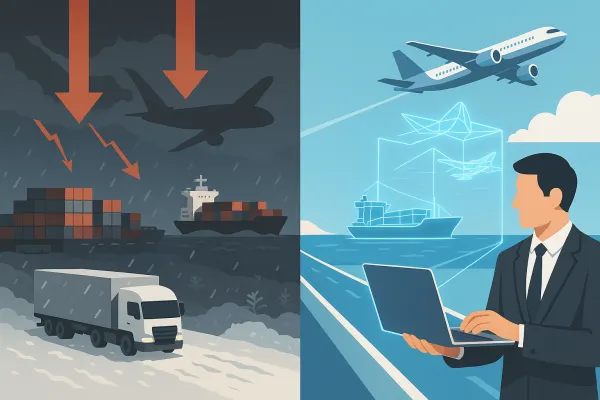
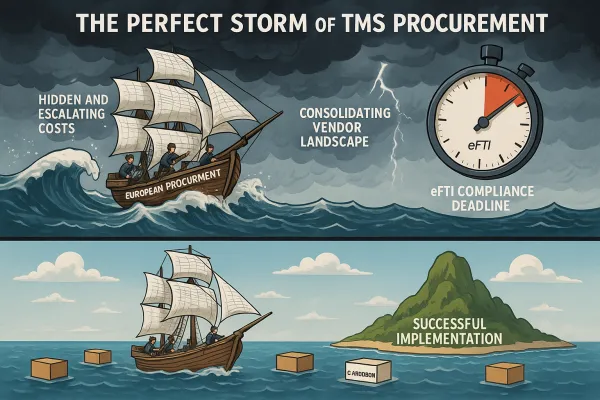
Modern Transportation's $5M multi-tenant TMS savings seem impressive, but that success story masks a procurement nightmare building across European transport departments. The most significant TMS vendor consolidation wave in over a decade is reshaping European procurement decisions right now. WiseTech's acquisition of E2open in 2025, Descartes' purchase of 3GTMS for $115 million in March 2025, and Körber's transformation of MercuryGate into Infios following their 2024 acquisition represent just the beginning of a fundamental market restructuring that's forcing procurement teams to completely recalibrate their risk models.
In early 2025, researchers identified a flaw — later assigned as CVE-2025-55241 — in Microsoft Entra ID (formerly Azure Active Directory) that could allow attackers to impersonate global administrators across tenants, highlighting just how quickly multi-tenant environments can expose entire organizations to catastrophic breaches. The stakes for getting procurement decisions wrong have never been higher.
The Multi-Tenant TMS Dilemma: Why European Procurement Teams Are Caught Between Cost Savings and Risk Exposure
The cost advantages of multi-tenant SaaS come from several important areas. First, shared infrastructure allows computing resources to be efficiently distributed across many users, enabling better utilization during peak periods. Second, shared overhead means costs for cybersecurity, compliance, and other overhead expenses are spread across all customers rather than borne by a single organization. These benefits explain why companies report substantial savings.
Yet procurement teams miss the hidden costs buried in shared environments. In a multi-tenant setup, multiple users share the same physical server or virtualized environment. If security controls aren't tight, a weakness in one tenant's application could let an attacker slip into another tenant's data. You're not just buying software; you're accepting shared risk with every other customer on the platform.
Market Consolidation Creates New Procurement Urgency
The $115 million acquisition of 3GTMS by Descartes Systems Group in March represents more than just another deal sheet headline. This marks Descartes' 32nd acquisition since 2016, and signals a fundamental shift in how procurement teams need to approach TMS vendor selection and contract negotiations across Europe. This growth is happening alongside unprecedented consolidation that's eliminating choice and creating new risks for procurement teams who thought they had plenty of time to evaluate options.
When mega-vendors like WiseTech absorb platforms with millions of users, your procurement timeline suddenly accelerates. Product roadmaps get consolidated, support structures merge, and the competitive leverage you've spent years building vanishes overnight.
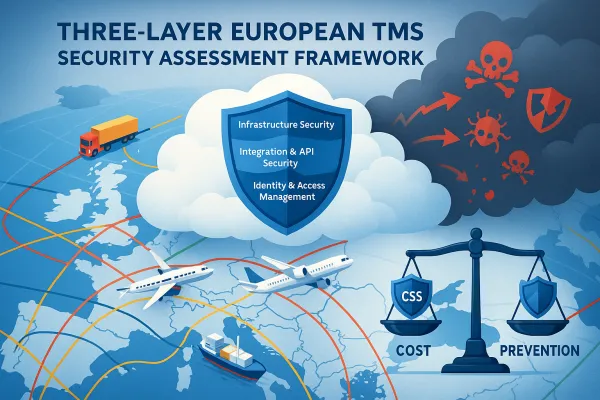
Multi-Tenant Architecture Security Risks That Standard TMS Evaluations Miss
While logical isolation is usually controlled by virtualization and hypervisors, vulnerabilities in shared infrastructure components could potentially permit unwanted cross-tenant access. Standard vendor security questionnaires don't probe deep enough into the architectural boundaries that actually protect your data.
Shared storage mismanagement: If multiple clients store data in a shared location, poorly implemented data isolation can expose one tenant's data to another tenant's retrieval. Side-channel attacks: Attackers can use shared resources, like CPU or memory caches, to potentially infer sensitive information from neighboring tenants. Network vulnerabilities: Insufficient segmentation between tenants' networks can create potential pathways for attackers to move between tenants.
Here's what procurement teams overlook: multi-tenant TMS platforms process shipment data from competitors, suppliers, and customers simultaneously. In multi-tenant architectures, improper data separation between clients can create security risks. A configuration error could expose your carrier rates to competitors or leak customer delivery patterns to third parties.
The €4.45M Data Breach Reality Check
While global average breach costs decreased to $4.44 million in 2025, significant variations emerged based on data sensitivity levels and industry regulatory frameworks. For European organizations, European Union costs at $189 per record reflect GDPR's comprehensive impact on breach notification requirements.
Transport data amplifies these costs. Shipment records contain customer information, supplier details, pricing data, and route intelligence. A single compromise affects multiple stakeholder categories, triggering cascading notification requirements under GDPR. An aggregate total of EUR1.2 billion (USD1.26 billion/GBP996 million) in fines issued across Europe in 2024 shows regulators aren't backing down on enforcement.
Vendor Lock-In Traps Hidden in Multi-Tenant TMS Contracts
A single application-level vulnerability, a compromised set of privileged credentials, or a malicious database administrator (DBA) can result in a catastrophic breach, exposing the sensitive data of all tenants simultaneously. But the real trap isn't just security exposure; it's architectural dependency.
Multi-tenant platforms create lock-in through shared infrastructure that goes beyond contract terms. Your data gets optimized for their specific architecture. Integration patterns become platform-specific. Carrier connectivity relies on their shared network effects.
The Three Lock-In Mechanisms Procurement Teams Don't See Coming
Technical lock-in through shared APIs: Multi-tenant platforms often develop proprietary integration standards that work beautifully within their ecosystem but create export challenges. When you want to move your data, you discover that carrier connections, rate tables, and workflow configurations don't translate cleanly to other platforms.
Financial lock-in through volume commitments across tenants: Shared infrastructure allows computing resources to be efficiently distributed across many users, enabling better utilization during peak periods. Vendors leverage this shared capacity to offer volume discounts tied to the entire platform's usage, not just yours. Leave the platform and lose pricing benefits that may have justified your business case.
Operational lock-in through shared workflow dependencies: Multi-tenant TMS platforms often enable cross-customer workflow optimizations, like consolidated carrier bookings or shared route optimization. These efficiencies become business dependencies that make switching platforms operationally disruptive.
The European Multi-Tenant TMS Due Diligence Framework
Tenant-specific SLAs and security agreements: Security must be clearly defined in service-level agreements (SLAs), in particular in vertical markets like government, health care, and finance. Transport procurement demands similar rigor given the commercial sensitivity of logistics data.
Your evaluation process needs architectural verification beyond standard vendor presentations. Logical Separation: Utilize database schemas, table partitioning, or separate databases to create logical boundaries between tenants' data. Ask for evidence, not assurances.
Technical Assessment Criteria
Data isolation verification methods: Request tenant isolation test results, not just architectural diagrams. Demand evidence that your shipment data physically resides in segregated storage with cryptographic boundaries. Per-tenant cryptographic isolation is a powerful and demonstrable control for meeting these requirements. It provides auditors with clear evidence that tenant data is not only logically but also cryptographically separated.
Backup and recovery in shared environments: Network Segmentation: Utilize virtual private networks (VPNs) and virtual local area networks (VLANs) to create isolated network segments for each tenant, minimizing the risk of lateral movement in case of a security breach. Verify that backup procedures maintain tenant isolation and that your data can be recovered without exposing other customers' information.
Performance isolation guarantees: If things aren't properly isolated, a spike in usage from one tenant could lead to sluggish performance or worse, complete downtime for others. Secure SLA guarantees that another customer's peak shipping season won't degrade your platform performance during critical booking periods.
Contract Negotiation Strategies for Multi-Tenant TMS Protection
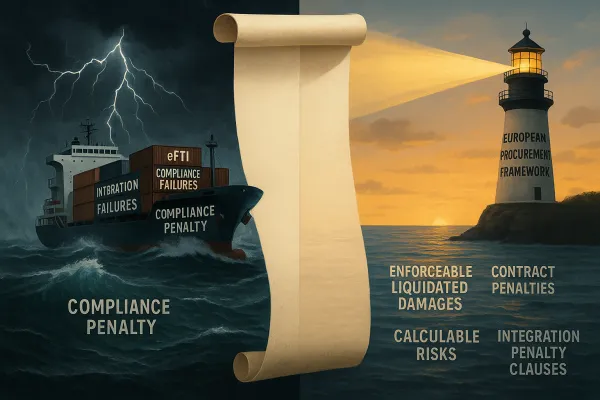
Keep all network activity, configuration changes, admin activity, and access requests in a permanent and tamper-proof record state. The requirements of security and compliance are that they are time-stamped and tenant-isolated and tamper-proof. Standard TMS contracts don't include adequate audit trail provisions for multi-tenant environments.
The Essential Multi-Tenant Contract Clauses
Security incident notification within 24 hours: GDPR requires breach notification within 72 hours, but you need internal notification faster. Include contractual obligations for immediate notification of any security incident affecting the shared platform, regardless of whether it directly impacts your data.
Quarterly security audits and reporting: Implement comprehensive logging and monitoring systems to track access attempts, data modifications, and potential security incidents. Conduct regular security audits to identify and address vulnerabilities. Your contract should mandate regular tenant-specific security reports showing access patterns, configuration changes, and isolation validation.
Data export guarantees with format specifications: Establish clear policies and procedures for data creation, storage, retention, and deletion. Ensure that tenant data is securely wiped when no longer needed or when a tenant terminates their service. Specify exact data formats, export timelines, and validation procedures for contract termination scenarios.
Building a Balanced Multi-Tenant TMS Strategy: When Benefits Outweigh Risks
The post-consolidation landscape reveals three distinct categories: global mega-vendors (Infios/MercuryGate, Descartes, SAP TM, Oracle TM, E2open/WiseTech), European specialists (Alpega, nShift, Transporeon/Trimble), and emerging European-native solutions (including Cargoson) that focus specifically on cross-border European operations.
Multi-tenant solutions make sense when shared infrastructure benefits outweigh isolation risks. Companies with predictable shipping patterns, limited customization needs, and mature data governance often find the economic benefits compelling. Cloud-based TMS platforms operate on subscription pricing, with user fees ranging from $50 to $500 monthly. Recent industry research indicates significant savings on initial setup when compared to traditional installation methods.
For European operations requiring rapid deployment and carrier connectivity, platforms like Cargoson alongside established players like Oracle TM, SAP TM, and MercuryGate provide different risk-reward profiles. European-native solutions offer rapid deployment and local expertise but may have limited feature depth compared to enterprise platforms. European-built solutions are gaining market share precisely because they understand the unique challenges of cross-border European operations.
The decision framework comes down to three factors: your data sensitivity level, your tolerance for shared infrastructure risks, and your ability to execute robust vendor management. Organizations with strong procurement governance and clear exit strategies can capture multi-tenant benefits while mitigating architectural dependencies.
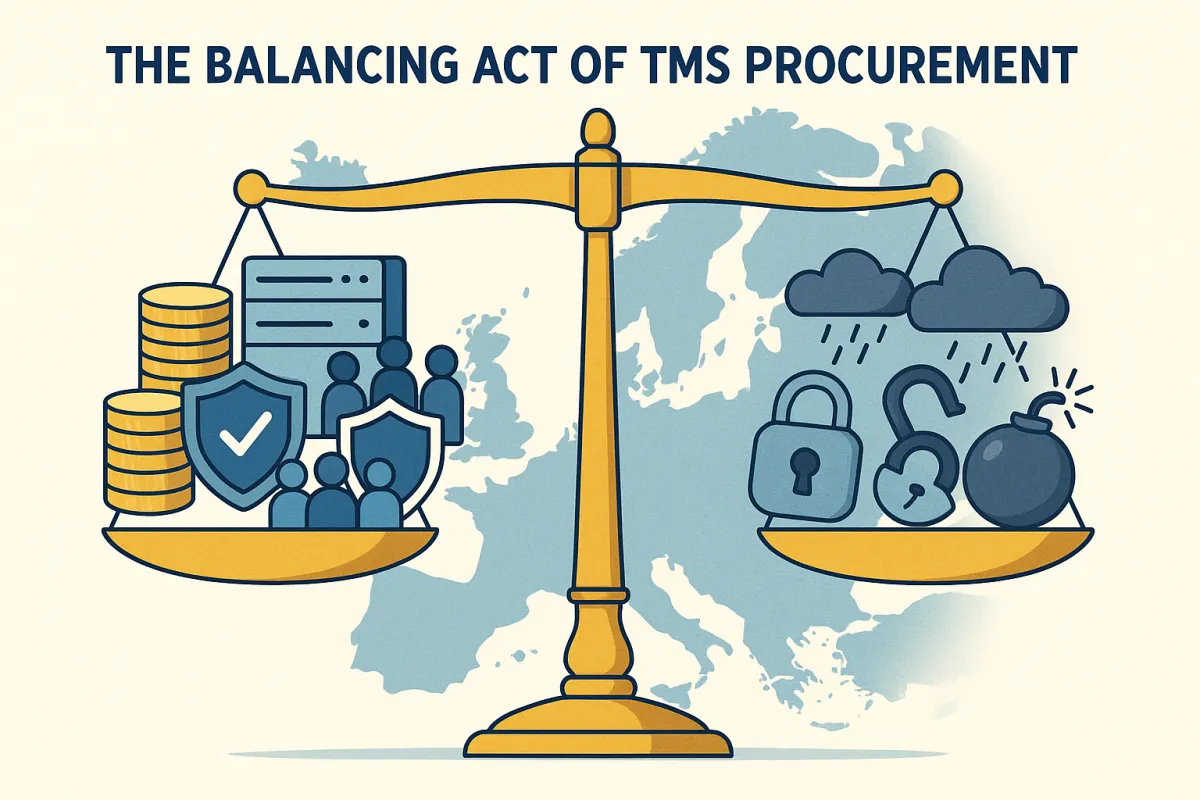
Multi-tenant TMS procurement requires balancing genuine cost benefits against hidden security and lock-in risks. While no single approach can eliminate all risks, a combination of robust encryption, continuous monitoring, identity and access management (IAM), and zero-trust architecture significantly reduces vulnerabilities. Success demands architectural due diligence that goes beyond standard procurement playbooks and contract protection that addresses the unique challenges of shared environments.