TMS API Integration Crisis: The European Procurement Framework That Prevents EDI Transition Disasters While Ensuring 2026 Regulatory Compliance


A sobering calculation confronts European procurement teams: 66% of technology projects end in partial or total failure, while a German automotive manufacturer discovered their €800,000 TMS implementation mistake the hard way. Six months into deployment, they found their European carriers couldn't integrate without costly custom development work - turning their "smart procurement decision" into a complete platform re-implementation.
The stakes get higher when you add 2026's regulatory compliance requirements. As of July 2027, this data may be shared via secure, eFTI-certified IT platforms, creating an unprecedented convergence of technology transitions and regulatory deadlines that most procurement teams aren't prepared for.
The Hidden Cost of TMS Integration Failures
The German manufacturer's story illustrates what happens when procurement teams focus on features instead of integration architecture. Six months into deployment, they realized their new system couldn't handle their complex carrier network across 12 European countries. Their mistake? Treating API integration as a technical afterthought rather than a strategic foundation.
Basic API integrations cost €5,000-€15,000, while complex ERP connections exceed €50,000. But that's just the software cost. Six months post-implementation, their carrier integration failures were costing them 15% more than their old spreadsheet-based system. Add integration delays, change management issues, and operational disruption during the failed rollout, and total costs approached €2.8 million.
The failure patterns are predictable. Data mapping complexity between transportation management systems, ERP platforms, and legacy systems creates the first major failure point. European operations span 27 different regulatory frameworks, each requiring specific data formats, reporting schedules, and compliance documentation. Your TMS needs to harmonize master data across these varying requirements while maintaining real-time synchronization capabilities.
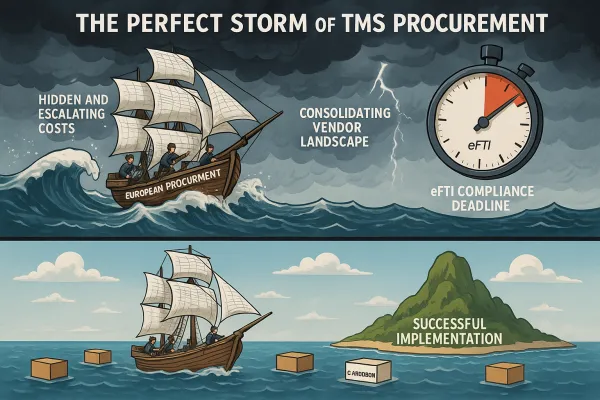
The 2026 Regulatory Compliance Perfect Storm
European shippers face an unprecedented convergence of regulatory requirements that fundamentally alters the TMS procurement landscape. As of January 2026: eFTI platforms and service providers can start preparing for operations. Member States authorities may start accepting data stored on certified eFTI platforms for inspection.
The timeline is immovable. As of July 2027, this data may be shared via secure, eFTI-certified IT platforms that can be easily integrated into companies' existing data management systems. The companies will then be able to share standardised freight transport data with the authorities and business partners.
Beyond eFTI, multiple regulatory streams create overlapping compliance requirements. Starting 19 August 2025, all heavy-duty vehicles registered in the EU and operating in Member States other than their Member State of registration must be fitted with G2V2 devices. Add dangerous goods transport changes and tachograph requirements for vans, and you have a regulatory perfect storm.
The economic impact is substantial. It could save the EU transport and logistics sector up to €1 billion per year, but only for organizations that implement compliant systems correctly. Those that don't face significant penalties, with some countries imposing fines up to 30,000 euros.
EDI vs API: Why the Transition Creates Procurement Risk
Most procurement teams underestimate the fundamental differences between EDI and API integration. EDI bundles orders, invoices, and shipment notices into standard file formats like X12 and UN/EDIFACT. Because the files move on a fixed schedule, updates can take hours to reach the next system.
APIs operate differently. Modern APIs can push the same information in real time. Speed – Messages travel in seconds instead of hours, and trigger pick tickets sooner. This creates a technical divide that impacts both integration costs and operational capabilities.
The "hybrid tax" becomes expensive quickly. Most logistics providers and shippers are now paying a "Hybrid Tax", the literal and operational cost of running two completely different technical infrastructures to accomplish the exact same goal: moving data from Point A to Point B. When your engineering team has to spend their morning debugging a flat-file EDI error and their afternoon optimizing a JSON payload, they aren't building new features. They are playing "Logistics Plumber." The cognitive load of switching between these protocols leads to slower deployments and higher burnout.
For European operations, the complexity multiplies. A large portion of shippers and manufacturers outside Fortune 500 companies still use legacy systems. McKinsey & Co. states that companies on average are less than 40 percent digitized, including everything from deployments of digital tools in their supply chains to customer-facing products and services. Those systems simply aren't ready for API integration.
The API-First Procurement Selection Framework
Smart procurement teams are building selection frameworks that prioritize API-first architecture while maintaining EDI compatibility. The framework starts with five evaluation criteria that separate genuine API capabilities from marketing claims.
Data Integration Architecture: Can the platform consume data from your existing ERP, TMS, carrier APIs, and telematics without custom development? Can it consume data from your existing ERP, TMS, carrier APIs, and telematics without custom development?
Real-Time Processing Capabilities: Test actual response times under load conditions, not just demo scenarios. APIs refresh dashboards in seconds, giving teams time to adjust labor, inventory, or routing before costs mount.
European Regulatory Compliance: Verify eFTI readiness isn't just a roadmap promise. Leading TMS providers like MercuryGate, Descartes, and Cargoson are already preparing eFTI-compatible solutions. The key is choosing platforms that combine regulatory compliance with transport optimization capabilities.
Hybrid Integration Support: Modern integration platforms now blend EDI's standardized reliability with API's real-time capabilities, creating powerful hybrid systems that maximize the strengths of both approaches. Hybrid API/EDI integration enables businesses to maintain EDI's structured document exchange while adding API-driven speed.
Implementation Timeline: Evaluate deployment speed against complexity. Most machinery manufacturers are live in 1-2 weeks. We import your carrier rate cards in any format, set up API connections, and provide go-live training. Compare this to 6-18 month implementations typical of enterprise TMS platforms.
Vendor Landscape Analysis: Who's Ready for API-First Operations
The vendor landscape divides into distinct categories with different API maturity levels. European specialists have focused on API-first architectures to handle cross-border complexity, while global platforms are retrofitting API capabilities onto existing EDI-based systems.
European API-Native Solutions: Cargoson focuses exclusively on shippers rather than carriers, with native API architecture designed for European manufacturing and wholesale companies. Cargoson focuses exclusively on shippers rather than carriers, addressing specific challenges of manufacturing and wholesale companies. Alpega, nShift, and Transporeon offer similar European-focused capabilities.
Global Enterprise Platforms: Oracle TM, SAP TM, and Blue Yonder provide comprehensive solutions but with complex implementations. Major players like Oracle TM, SAP TM, and Blue Yonder offer enterprise-grade solutions, but implementation complexity often delays projects.
Hybrid Specialists: MercuryGate (now Infios) and Descartes Systems Group balance API capabilities with strong EDI heritage. Leading TMS providers like MercuryGate, Descartes, and Cargoson are already preparing eFTI-compatible solutions. The key is choosing platforms that combine regulatory compliance with transport optimization capabilities. European shippers evaluating platforms should understand that vendors like MercuryGate (now Infios), Blue Yonder, Oracle TM, and Cargoson are implementing these advanced integration capabilities.
Integration timeline varies significantly by vendor category. European specialists typically deploy in weeks, enterprise platforms require months, and hybrid solutions fall somewhere between based on implementation complexity.
Implementation Risk Mitigation Strategies
Successful API-first implementations require proactive risk management that addresses both technical and organizational challenges. The key is treating integration as an organizational transformation rather than a technical project.
Phased Rollout Approach: Start with a single corridor or specific use case rather than attempting comprehensive network modeling. They tried to model their entire European network simultaneously instead of starting with a single corridor or specific use case. The project takes two years. Analysis paralysis and stakeholder fatigue.
Data Quality Foundation: Centralize data sources: Connect ERP, WMS, TMS, IoT sensors, and external partner systems to a unified platform. Standardize metrics and definitions: Align KPIs, units of measure, and reporting formats across all tools. Your implementation roadmap should establish data integration across all transport-related systems before attempting advanced modeling.
Testing Protocols: Use actual historical data for integration testing, not synthetic test cases. Validate data flows under peak load conditions, not just steady-state operations. Test failure scenarios and recovery procedures before production deployment.
Change Management: Effectively responding to team resistance and incorporating feedback increased the odds of transformation success by 62%, while 81% of logistics leaders believe that transformation is critical, yet only 20% adopted the approach of using resistance as a resource to leverage the collective wisdom of their teams to improve transformation outcomes. Adopting this less common approach dramatically improved the odds of transformation success by 62%.
Budget planning should account for European complexity. Add 20-30% contingency reserves for European implementations, given the complexity of multi-country operations and evolving regulatory requirements.
2026 Procurement Action Plan and Contract Protection
The window for strategic TMS procurement is narrowing rapidly. By mid-2026, Member States are expected to have national systems ready to connect to the EU's digital logistics environment. The mandatory acceptance of electronic freight data from July 2027 will make eCMR an operational reality in most international transport corridors.
Timeline Requirements: Start evaluation by mid-2026 or face limited vendor options and compressed implementation schedules. As of 9 July 2027: The eFTI Regulation will apply in full. Member State authorities must accept information shared electronically by operators via certified eFTI platforms. Your timeline planning must align with this immovable deadline while building in sufficient testing and optimization phases.
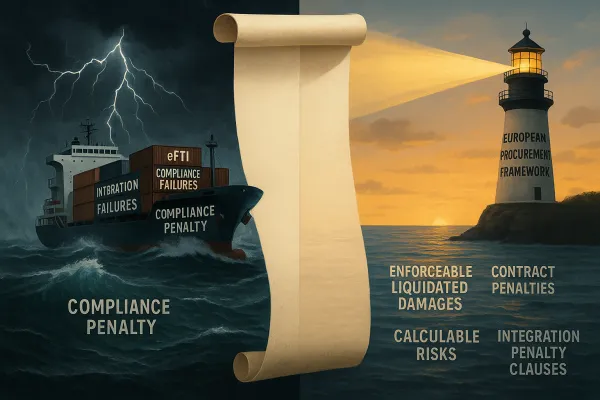
Contract Protection Strategies: Include API performance guarantees with specific response time requirements and uptime commitments. Build in regulatory compliance milestone requirements with penalties for delays. Negotiate vendor support requirements during the EDI-to-API transition period.
Vendor Consolidation Risks: The market is experiencing significant consolidation that affects long-term procurement strategy. WiseTech Global's $2.1 billion acquisition of E2open, expected to complete in 1H26, alongside Descartes Systems Group's $115 million acquisition of 3GTMS in March demonstrates how quickly the vendor landscape changes.
Success Metrics Framework: Focus on operational performance indicators rather than technical metrics. ROI should be measured using operational performance indicators such as: These metrics determine whether expanding AI autonomy is safe and economically justified. Focus on impact metrics rather than activity volume: cost reduction, service level improvements, cycle time compression, and planner productivity gains provide clearer success indicators than automation rates or system usage statistics.
The choice facing European procurement teams is clear: build API-first selection frameworks now, or join the 66% of implementations that fail to meet their objectives. The regulatory compliance deadlines are immovable, but the procurement window is still open for teams that act strategically while vendor options remain available.