TMS API Integration: The Procurement Evaluation Framework That Prevents €800K+ Implementation Disasters


A German automotive parts manufacturer just learned what a €800,000 TMS implementation mistake looks like. They chose a North American-focused platform six months before discovering their primary carriers couldn't integrate without costly custom development. This isn't an isolated case—76% of logistics transformations fail to achieve their performance objectives, with procurement blind spots creating most of the damage.
You're reading this because your organization needs a transport management system API integration strategy that actually works. European shippers face unique challenges: European shippers managing €10 million+ annual transport spend are facing an unprecedented cost squeeze in 2025. The EU ETS now requires shipping firms to surrender 70% of 2025 emissions (up from 40%), with compliance costs rising significantly. Meanwhile, hidden costs in TMS procurement consistently add 25-30% more than initial estimates, turning what looked like smart investments into budget disasters.
This procurement evaluation framework prevents those disasters by exposing the real costs, technical gaps, and contract risks that vendors prefer you don't discover until after signature.
The €800K Reality Check: Why API Integration Fails at Procurement Stage
That German automotive manufacturer's story gets worse. They discovered six months in, with €800,000 already spent, that their new system couldn't handle their complex carrier network across 12 countries. The platform worked perfectly—in North America. But their European carriers required EDI protocols the system couldn't support without extensive custom development.
Sound familiar? Companies buy platforms expecting smooth rollouts, then discover their carrier relationships don't fit standard workflows. Integration projects drag on for months while teams juggle multiple systems that don't talk to each other. The costs compound rapidly: Failed implementations waste budget and time, but they also damage relationships with carriers and customers who experience service disruptions.
The pattern repeats across Europe. Research indicates that 60% of organizations encounter difficulties when linking new platforms with legacy technologies, yet procurement teams consistently underestimate integration complexity.
The Procurement Blind Spot: What API Specs Don't Tell You
Here's what catches finance controllers off-guard: Treasury teams often discover during the process that they lack the licences or modules needed for API connectivity, underscoring the need for rigorous contract management and close relationships with TMS vendors. As one treasury director noted: "You have to really understand what your contractual rights are and whether the technology is actually included in what you've purchased".
Vendors showcase impressive API documentation during demos, but the reality hits during implementation. The costs of integrating APIs into a TMS system can vary depending on the level of customization required. If you need significant customization, the costs can be higher. Most procurement teams discover too late that API availability doesn't equal API compatibility with their specific carrier ecosystem.
The European Carrier Integration Challenge
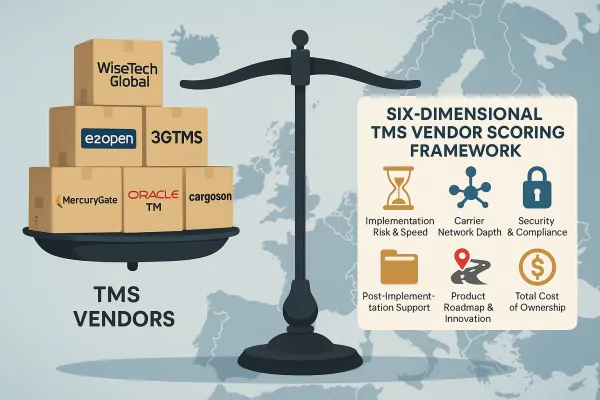
European transport management creates a unique integration challenge. Your carriers span from digitally advanced logistics giants to traditional hauliers who still prefer fax. Modern transport execution software addresses many of these challenges by providing unified platforms that handle EDI, API, and hybrid communication methods from a single interface. Solutions from providers like Cargoson, MercuryGate, and Descartes are evolving to support this unified approach.
This creates a mixed environment where your TMS must handle both integration types effectively. Platforms like Cargoson, alongside solutions from Transporeon, nShift, and others, have responded by offering dual-mode capabilities. This approach acknowledges that European shippers don't have the luxury of choosing just one integration standard.
But here's the procurement trap: USA Truck discovered their EDI tools couldn't scale when they expanded their carrier network from 200 to 500+ partners. Processing times increased from 2 minutes to 45 minutes for standard load tenders. The technical specifications looked identical, but real-world performance diverged dramatically.
Hidden Cost #1: Carrier API Integration Fees
Carrier connectivity represents one of the largest hidden cost areas. Some TMS providers offer published APIs for carrier integration, but carriers may charge shippers for establishing these connections. The math gets brutal quickly: Adding new carrier integrations costs approximately $3,000 per carrier, with carriers typically implementing standard EDI/XML messages themselves.
Meanwhile, requesting completely new carrier API/EDI integrations is complex and costly - many providers don't build custom integrations themselves but provide standard EDI interfaces that carriers must implement. You're paying for connectivity that may never materialize.
Compare this across vendors: Alpega connects to 80,000+ European transport professionals, MercuryGate offers broad North American coverage, and Cargoson focuses on European API/EDI connections. Cargoson builds true API/EDI connections with carriers, not just accounts in software or standardized EDI messages that carriers must implement themselves.
The Procurement Due Diligence Framework
Successful transport management system procurement requires a systematic approach to evaluating API integration capabilities. Your procurement team needs to move beyond feature checklists to understand operational reality.
Start by mapping your current carrier ecosystem. Document which carriers handle what percentage of your volume, their technical capabilities, and integration preferences. Research by Ovum shows that 53% of enterprises experience limitations with their current B2B integration solutions when onboarding trading partners, with approximately 40% requiring over 30 days to bring a new partner online.
Involve your ERP and IT experts early. Technical evaluations should focus as much on connectivity capabilities as core TMS functionality, because even the most sophisticated freight management features become useless when isolated from operational reality. Work closely with your IT team to assess the TMS's API structure, data mapping capabilities, and customization requirements.
Request a proof of concept before full implementation. Test the TMS in a sandbox environment integrated with your SAP or Oracle system. At PayPal, the treasury management system was underused. Users had introduced bots to automate tasks that could have been handled natively within the TMS. "When they did the demo, you could just check a box in your TMS and whatever the bot was doing could be undone," she explained.
Technical Evaluation Checklist
Focus your technical due diligence on specific integration capabilities that matter in operational reality:
- API documentation quality and completeness
- Real-world integration examples in your industry vertical
- Carrier network size and European coverage depth
- Support for both API and EDI protocols
- Data mapping flexibility for your ERP requirements
- Testing and sandbox environment availability
- Integration monitoring and error handling capabilities
The value is directly related to the data you can capture and submit. But, just because a vendor or business partner offers an API for your TMS to connect with does not mean it will provide all the data points you need. Test data completeness, not just connectivity.
Contract Protection Strategies
Build protection into your TMS contract to prevent cost overruns and capability gaps:
- Integration milestone payments tied to specific carrier connections
- Carrier onboarding SLAs with penalty clauses
- API uptime guarantees with service credits
- Fixed-price carrier integration commitments
- Change request cost caps for first-year modifications
- Data accuracy warranties for API data feeds
Watch for these warning signs during procurement: reluctance to provide detailed cost breakdowns, vague implementation timelines, limited references in your industry vertical, and unclear change request processes.
2025 Integration Strategy: API vs EDI vs Hybrid
Your integration strategy depends on operational profile, not vendor preferences. APIs transmit data in milliseconds. This allows a transportation management system (TMS) to run on real-time data, whether you're getting tracking updates, building loads or getting spot quotes. For European shippers managing just-in-time operations or responding to supply chain disruptions, this speed difference becomes critical.
Choose EDI when you're managing stable, high-volume lanes with established carrier relationships. The most common and easily recognizable technology used in TMS is electronic data interchange (EDI). This type of connection relies on a set of shared data among systems, triggering an action between multiple systems. Although EDI is an 'older' process of exchanging data, a big part of the reason it's still around is very simple: EDI is cost-effective and it works reliably.
However, while EDI is leading in terms of connecting technologies used in TMS deployment, API connectivity is increasing, especially among parcel and LTL freight carriers. The trend reflects changing carrier capabilities and customer expectations.
Cost Impact Analysis
Model your total cost of ownership across integration approaches. While I can understand the skeptics' perception that the cost of licensing or subscription fees to acquire the TMS would be the primary 'cost' line item, in my 25 years of implementing logistics technology like TMS, it is very rarely the case. In fact, for most shippers with annual freight under management (FUM) greater than $250M, the implementation line item can be 2-3x the subscription. Furthermore, the "long pole of the tent" of implementation time, and therefore cost, resides in the design, build, and testing of integrations.
Factor in compliance costs that many procurement teams miss. European shippers managing €10 million+ annual transport spend are facing an unprecedented cost squeeze in 2025. The EU ETS now requires shipping firms to surrender 70% of 2025 emissions (up from 40%), with compliance costs rising significantly. Maersk expects emission surcharges in 2025 to be nearly double that of 2024.
Consider infrastructure requirements: Calculate infrastructure costs including server hardware (on-premise), network bandwidth, backup systems, security measures, and compliance auditing. Cloud solutions shift these to operational expenses but may include usage-based charges that escalate with shipment volumes.
Implementation Governance That Works
Even perfect technical evaluation fails without proper implementation governance. Next-generation integrations between APIs, TMS, and ERP are less about advanced technology and more about smart architecture, stakeholder management, and disciplined execution. As Palamuttam summed up, success comes from understanding your architecture, managing costs, influencing decision-makers, and deploying targeted solutions—not chasing trends.
While API integration technologies facilitate basic system connections, the true challenge lies in managing revisions and changes. Organizations must thoroughly identify and address change management scenarios during implementation. A system that functions well for standard operations but falters during revisions can severely impact operations, forcing businesses into reactive problem-solving modes.
Cost management: 70% of companies exceed their project budgets due to unforeseen complexities. Custom builds allow for precise budgeting by accommodating specific needs without unnecessary features. Build budget contingency for the reality that no integration plan survives first contact with your operational environment.
Vendor Selection Red Flags
Recognize these warning signs that predict implementation disasters:
- Reluctance to provide detailed cost breakdowns
- Vague implementation timelines without milestone specifics
- Limited references in your industry vertical or geographic region
- Unclear change request processes and pricing
- Demonstrations that avoid technical integration details
- Claims of "out-of-the-box" connectivity without proof-of-concept testing
Executives dump the project on IT and walk away – Leadership treats TMS like any other software purchase without realizing it changes how every department handles freight decisions, customer commitments, and vendor relationships, creating TMS implementation mistakes from the start. Logistics teams stick to their spreadsheets – Experienced freight coordinators who've been managing carriers and routes for years resist abandoning methods that work for them, especially when nobody explains why the new system is actually better.
Your procurement framework needs to address both technical capabilities and organizational change management. The €800,000 failures happen when procurement focuses entirely on features while ignoring the human and process elements that determine success. Build vendor accountability for user adoption, not just technical delivery.
The transport management system market continues evolving rapidly, with the European TMS market reaching around € 1.4 billion in 2024 and growing at a compound annual growth rate (CAGR) of 12.2 percent, forecasted to reach € 2.5 billion in 2029. Your integration strategy must balance current operational needs with future scalability requirements. Choose platforms that handle the complexity of European transport management while positioning your organization for whatever comes next.