TMS Carbon Reporting: The CSRD Procurement Framework That Prevents Sustainability Feature Markup While Ensuring Compliance

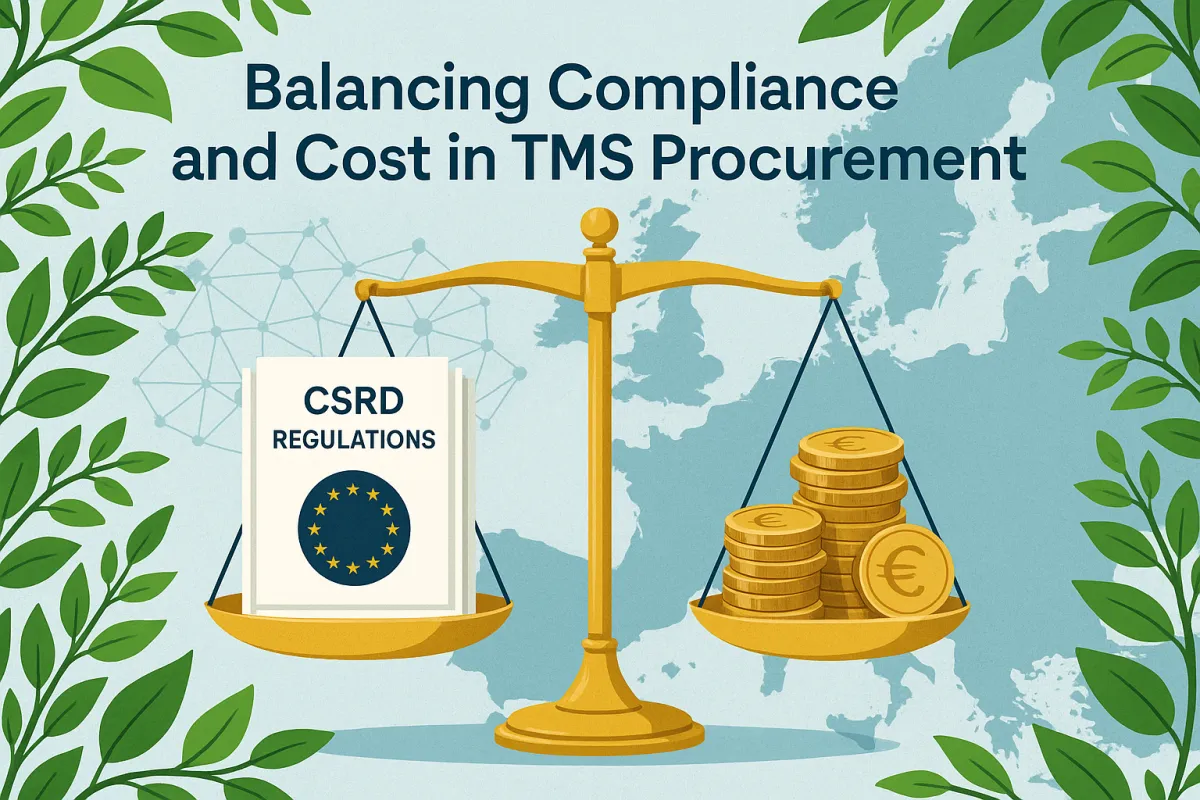
European procurement teams are navigating CSRD requirements that mandate detailed carbon emissions reporting for freight transport, while simultaneously facing vendor sustainability feature markup that can inflate TMS budgets by 25-30% beyond initial estimates. This reality demands a structured procurement framework that delivers both regulatory compliance and cost control.
CSRD's Impact on TMS Procurement Decisions
The EU's Corporate Sustainability Reporting Directive requires companies, especially large shippers, to disclose detailed information about their environmental impact, including carbon dioxide emissions from freight transport. The phased implementation affects different company sizes at different times: large companies meeting at least two of three criteria must publish their first sustainability report in 2026, covering the year 2025.
These emissions, classified as Scope 3, come from the broader value chain and emphasize whole supply chains. Shippers must measure and report emissions from all transport modes—road, sea, air, and rail. The compliance cost pressure is significant: one large multinational estimates it has spent $18m on automating its carbon-emissions data reporting and expects to spend another $50m-$60m.
Leading TMS vendors including MercuryGate, Descartes, Transporeon, and Cargoson are adapting their platforms. Cloud logistics software includes freight carbon emission calculations and sustainability reporting features that help shippers make environmentally conscious transport decisions. However, the challenge lies in the vendor pricing approaches for these capabilities.
The Carbon Reporting Feature Markup Problem
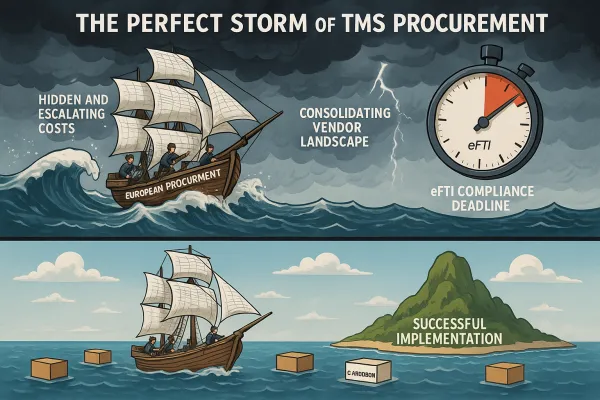
TMS vendors are systematically charging premiums for sustainability modules that procurement teams increasingly view as standard functionality. Hidden costs in TMS procurement consistently add 25-30% more than initial estimates, while procurement teams focus on feature checklists and license fees, missing the real financial impact from implementation complexity and ongoing maintenance expenses.
The markup manifests in several forms. Basic carbon tracking add-ons typically increase total system costs by 15-30%, even when the underlying calculation engines rely on standard emission factors from frameworks like GLEC (Global Logistics Emissions Council). These premium pricing strategies exploit urgent compliance timelines and regulatory uncertainty.
Integration costs with emissions databases create additional budget pressure. Basic API integrations typically cost between $5,000 and $15,000, while connecting with complex ERP systems might exceed $50,000. European shippers face particular challenges with 12-country carrier networks, multi-modal requirements, and regulatory compliance demands that create cost pressures basic TMS comparisons miss.
Procurement Red Flags: Overpriced Sustainability Modules
Watch for vendors positioning carbon tracking as premium functionality when cloud logistics software increasingly includes freight carbon emission calculations as standard features for meeting corporate sustainability goals and regulatory requirements. Solutions like Cargoson, Alpega, and nShift offer transparent carbon pricing integrated into their core platforms.
Data residency requirements for EU compliance add complexity. Information must be submitted digitally and machine-readable in XBRL format, requiring specific infrastructure investments that vendors may price separately. The key is distinguishing between legitimate compliance costs and artificial scarcity pricing.
The CSRD-Ready TMS Evaluation Framework
Procurement teams need evaluation criteria that balance compliance capability against cost inflation. Your RFP sustainability sections should include specific questions about emission calculation methodologies, data integration capabilities, and reporting format compatibility.
Core evaluation criteria should address: calculation accuracy using ISO 14083 standard published in March 2023, which is in line with recognized standards such as the GHG Protocol, ISO 14064 and the GLEC framework; real-time emission visibility during transport decision-making; and automated reporting generation for CSRD compliance.
Your scoring matrix should weight sustainability features appropriately without allowing vendors to exploit regulatory pressure. Platforms like Cargoson pioneered real-time transport emission calculation directly in the dashboard, allowing businesses to make environmentally friendly transport decisions, demonstrating that sustainability functionality can be core rather than premium.
Include Cargoson alongside Manhattan Active, Blue Yonder, and Oracle TM in comprehensive evaluations, focusing on functionality depth rather than marketing positioning.
Vendor Landscape: Carbon Reporting Capabilities
The market shows significant maturity variation in carbon reporting functionality. Pricing competition is shifting from licence fees to value-based models where cost recovery ties to documented savings, with vendors capable of quantifying carbon reductions in parallel with freight savings gaining strategic advantage.
Current feature depth ranges from basic CO2 calculations to comprehensive scope 3 reporting. Modern systems calculate estimated CO2 emission for each carrier and mode of transport before transport decisions, making company CO2 emissions reporting effortless. Integration capabilities vary significantly, with leading platforms connecting to major emissions databases and carrier APIs for real-time data.
Cargoson offers CO2 emissions calculation alongside price and transit times comparison in one cloud-based system, while traditional enterprise vendors often separate sustainability modules. The total addressable functionality should guide procurement decisions rather than individual feature availability.
Implementation Timeline Considerations
CSRD deadline pressure is affecting vendor selection cycles. The first CSRD reports must be prepared in 2025 covering the year 2024, with many smaller companies also affected by the "2025 for 2024" timeline. This urgency can drive procurement teams toward quick decisions that favor incumbent vendors or premium-priced solutions.
Cloud-based TMS implementation typically takes 1-4 weeks compared to 6-18 months for traditional on-premise systems, with solutions like Cargoson having shippers managing freight within days. Consider implementation speed as a risk mitigation factor rather than accepting sustainability feature markups from slower-deploying platforms.
Cost-Benefit Analysis: Compliance Investment vs Penalties
TCO modeling for sustainability-enabled TMS requires balancing compliance investment against penalty avoidance. European procurement teams are discovering their TMS budget calculations miss over half the true costs, with shippers facing complex procurement challenges that could cost over £200,000 in hidden expenses.
Budget allocation between core TMS functionality and sustainability modules should reflect actual regulatory requirements rather than vendor positioning. Traditional TMS systems cost €100,000+ annually and take months to install, while cloud-based alternatives start at €199/month, suggesting significant room for cost optimization.
ROI calculations must include penalty avoidance benefits. Companies must both calculate CO2 emissions and state clear reduction targets in their reports, as the CSRD requires companies to report not only their footprint, but also a reduction plan. The compliance value justifies sustainability functionality investment, but not unlimited markup.
Contract Negotiation: Sustainability SLAs
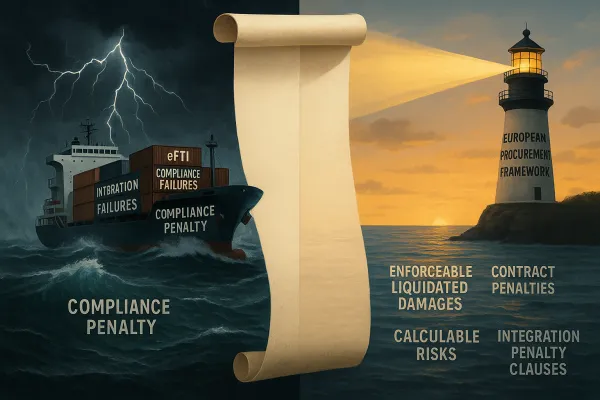
Performance guarantees for carbon data accuracy become critical when data must be recorded in a trustworthy manner in high quality and accordance with regulatory requirements, as auditors have to audit companies' CSRD reports. Your contracts should include specific accuracy thresholds and remediation procedures.
Future-proofing clauses should address evolving CSRD requirements without triggering automatic fee increases. From 1st of January 2026, the scope of application will be extended to large companies, with small and medium-sized enterprises affected as well one year later. Build scalability into your agreements rather than accepting vendor-controlled upgrade pricing.
The procurement reality is clear: CSRD compliance drives legitimate TMS investment, but vendor sustainability markups exploit regulatory urgency. Your framework should secure both compliance and cost control through structured evaluation, realistic TCO modeling, and performance-based contracting. The goal is regulatory compliance without vendor markup exploitation.