
TMS Contract Protection Clauses That Shield European Shippers From €800K Vendor Consolidation Disasters: The Acquisition-Resistant Procurement Framework for 2026's Regulatory Storm

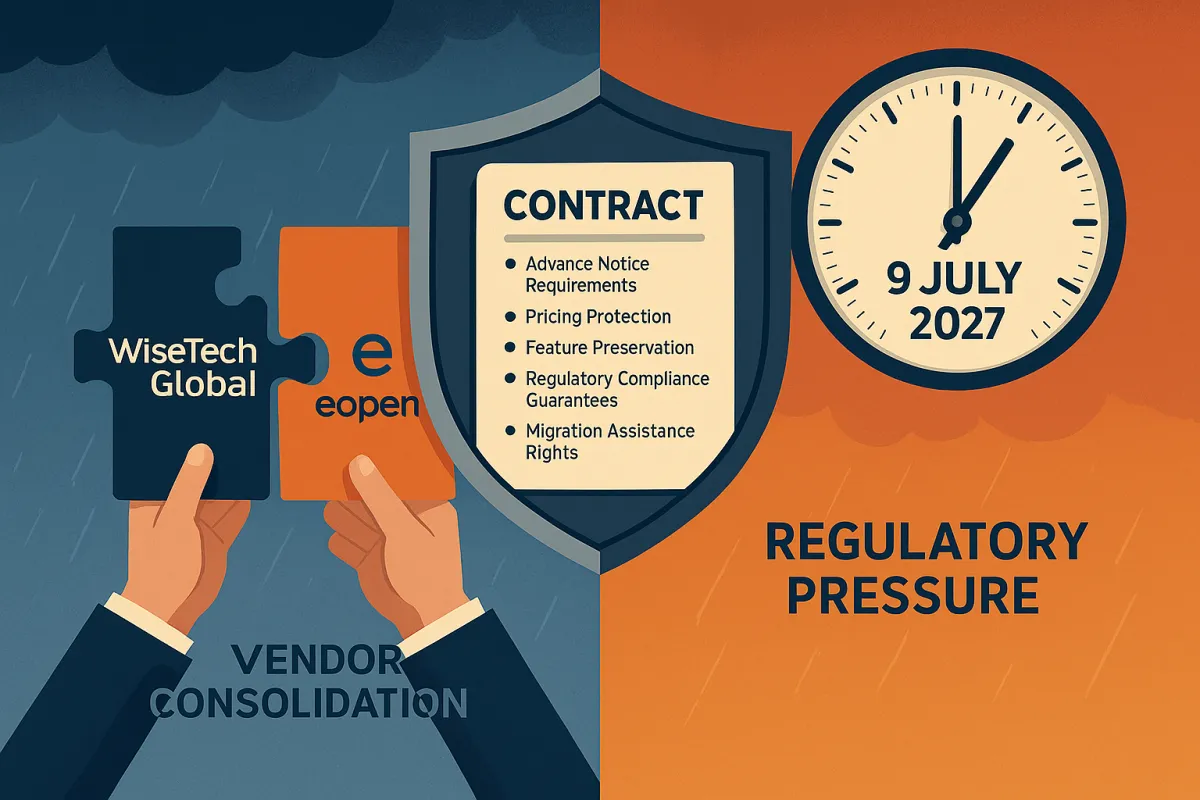
A German automotive manufacturer signed a three-year TMS renewal in early 2024 without regulatory compliance pricing protection. Nine months later, when their vendor introduced eFTI compliance as a premium add-on module, the additional licensing costs reached €800,000 annually. This disaster could have been prevented with proper contract protection clauses.
European procurement teams face more than traditional software selection risks. WiseTech Global's $2.1 billion acquisition of E2open and Descartes Systems Group's $115 million acquisition of 3GTMS for USD 115 million signal the most significant vendor consolidation wave in TMS market history. Meanwhile, 66% of technology projects end in partial or total failure, while 76% of logistics transformations never meet their budget, timeline, or performance targets.
The mathematics are unforgiving when vendor acquisitions collide with regulatory deadlines. Companies undergoing integration often experience 12-18 months of reduced innovation while they harmonize platforms and teams. When your vendor becomes an acquisition target, you inherit integration risks and delays without managing the project directly.
The Perfect Storm: Consolidation Meets Compliance Deadlines
Your procurement window narrows rapidly. The procurement window for securing optimal TMS platforms before vendor consolidation eliminates choices runs through Q1 2026. After this period, regulatory pressure forces reactive decisions while vendor options shrink.
European regulatory timelines create additional pressure. As of January 2026, eFTI platforms and service providers can start preparing for operations. Member States authorities may start accepting data stored on certified eFTI platforms for inspection. By 9 July 2027, the eFTI Regulation will apply in full. Member State authorities must accept information shared electronically by operators via certified eFTI platforms.
Budget planning shows stark differences between proactive and reactive approaches. Plan for 15-20% budget increases in 2026-2027 if reactive, or 8-12% if proactive with proper contract protection. The timeline pressure intensifies because companies must complete TMS selection and implementation before vendor resources get redirected to acquisition integrations.
Contract Protection Framework: 5 Critical Acquisition-Resistant Clauses
Standard TMS contracts leave you exposed to post-acquisition cost shocks. Standard TMS procurement contracts rarely address vendor acquisition scenarios, leaving European shippers vulnerable to post-acquisition service degradation that can derail operations. Here's how to build bulletproof protection:
Advance Notice Requirements: Include specific clauses requiring 12-18 months advance notice of ownership changes, with automatic contract review rights triggered by acquisition announcements. This gives you time to assess impacts and negotiate protection before integration disrupts service levels.
Pricing Protection: Price protection clauses locking pricing for 24 months following ownership changes prevent vendors from using acquisitions to renegotiate terms. This shields you from immediate cost increases during integration periods when you have limited negotiation leverage.
Feature Preservation: Contract language should specify that any feature deprecation requires equivalent functionality replacement or contract termination rights without penalty. When platforms merge, this prevents vendors from eliminating capabilities you depend on without providing alternatives.
Regulatory Compliance Guarantees: Regulatory Change Exclusions: Clauses that exclude vendor responsibility for regulatory compliance updates. Any TMS contract signed now should include eFTI and Smart Tachograph compliance as baseline requirements, not optional upgrades. Build regulatory deadlines into implementation timelines with penalty clauses for non-compliance.
Migration Assistance Rights: Functionality guarantee clauses protect against feature deprecation common during platform consolidation. Specify that current functionality levels must be maintained for minimum periods, with migration assistance provided if features are discontinued. This includes data portability provisions and technical support for system transitions.
Pricing Models That Protect Against Post-Acquisition Cost Shocks
TMS pricing structures vary significantly, but understanding total cost prevents budget disasters. Cloud TMS pricing ranges from $1.00 to $4.00 per freight load booked in the system, while licensed options demand significant upfront investment plus ongoing maintenance fees.
The pricing reality most procurement teams miss: Software license is typically only 20–25% of total cost of ownership—so "cheap" tools can still get expensive fast. TMS implementation costs range from €30,000 to €900,000, depending on complexity and vendor approach. But here's what catches European shippers off-guard: recurring costs spread over 10+ years while capacity shortage scenarios create additional cost pressures that standard budgets miss.
Cost breakdown patterns show predictable categories. Total cost breakdown includes base licensing 20-30%, implementation 25-40%, and carrier integration 15-25%. Carrier integration represents the largest hidden cost area during capacity crises. Custom EDI mappings, API rate limits, and carrier-specific data formatting requirements cost €5,000-€50,000 per connection.
European regulatory requirements multiply these costs further. These regulatory requirements multiply TMS implementation costs through mandatory integrations with government systems, telematics providers, and customs platforms. Your base integration estimate needs separate line items for ICS2 connectivity, eFTI compliance capabilities, and Smart Tachograph data processing.
The Vendor Landscape: Consolidation-Resistant Options
The post-acquisition vendor landscape reveals three distinct categories with different risk profiles. The post-consolidation landscape reveals three distinct categories: global mega-vendors (Oracle TM, SAP TM, E2open/WiseTech, Descartes), European specialists (Alpega, nShift, Transporeon), and emerging European-native solutions like Cargoson that maintain development focus specifically on European regulatory requirements.
Global mega-vendors offer comprehensive functionality but face integration complexity. Global mega-vendors provide comprehensive functionality and financial stability, but traditional providers like SAP TM and Oracle often struggle with localized European requirements. Their conversational AI modules are built for global markets, which means they lack the nuanced understanding of European transport corridors, seasonal capacity variations, and regulatory differences between EU member states.
European specialists provide market-specific advantages. Consider the benefits: Cargoson, Alpega, and other European specialists maintain development resources focused exclusively on European market needs, while global vendors like Descartes or WiseTech spread development efforts across multiple geographic priorities. This focus translates into faster feature development for European-specific requirements and more responsive customer support during regulatory transitions.
Financial stability assessment becomes critical during consolidation periods. Financial health indicators become critical evaluation criteria in a consolidating market. While WiseTech has demonstrated consistent profitability and growth, e2open has struggled with financial performance in recent years, reporting declining revenue and net losses in recent fiscal years.
When evaluating vendor options, consider established platforms like Oracle TM, SAP TM, and the combined WiseTech/E2open entity alongside European specialists including Cargoson, Alpega, nShift, and Transporeon. Each offers different approaches to acquisition risk and regulatory compliance support.
Implementation Timeline: 90-Day Action Plan
Your procurement timeline must account for both consolidation risks and regulatory deadlines. The procurement window for securing optimal TMS platforms before vendor consolidation eliminates choices and capacity shortages worsen cost structures runs through Q1 2026. This gives you approximately 3-4 months of leverage before capacity tightens again.
Days 1-30: Vendor Risk Assessment Conduct financial stability assessment beyond traditional metrics. Look beyond vendor marketing materials to examine cash flow statements, debt-to-equity ratios, and acquisition history patterns. Red flags include vendors actively seeking growth capital or rapid customer acquisition without proportional support infrastructure expansion. Identify potential acquirers by analyzing which larger players lack capabilities in your vendor's specialization areas.
Days 31-60: Contract Negotiation with Protection Clauses Include acquisition notification requirements, price protection clauses, functionality guarantees, and termination rights. Structure negotiations around regulatory deadlines for maximum leverage. Vendors face the same compliance pressures but with greater exposure to customer demands.
Days 61-90: Implementation with Regulatory Integration Member States authorities may start accepting data stored on certified eFTI platforms for inspection from January 2026. Use this voluntary period for real-world testing and staff training. QR code generation and machine-readable format requirements become mandatory by July 2027. Your TMS must generate these automatically for every shipment across all transport modes.
Beyond Contracts: Building Regulatory Compliance Partnerships
Successful TMS procurement treats vendors as compliance partners, not just software providers. According to the Commissioner for Sustainable Transport and Tourism Apostolos Tzitzikostas, the introduction of eFTI and digitalizing transport and logistics systems not only supports efficiency but also adds a significant cost saving of up to €1 billion per year for the industry.
Contract structures should include shared financial risk for compliance failures. Procurement teams should structure vendor evaluations around compliance readiness rather than traditional feature checklists. Instead of treating 2026 regulatory requirements as obstacles, procurement-savvy European shippers are using these deadlines as vendor selection criteria and contract negotiation leverage.
European-native vendors often provide compliance advantages. Consider Cargoson alongside consolidated platforms like Oracle TM, Blue Yonder, or the newly combined WiseTech/E2open entity. European-native vendors often provide better insulation against global consolidation dynamics while maintaining specialized corridor expertise.
Training and support requirements need contractual guarantees during transitions. Executive buy-in requires demonstrating competitive necessity, not just operational improvement. Marketplace integration changes procurement workflows, so invest in change management alongside technical implementation. Set realistic expectations: 60% time savings occur after teams adapt to new workflows, not on day one.
Your TMS contract protection strategy determines whether vendor consolidation and regulatory requirements become operational strengths or budget disasters. European shippers who implement these acquisition-resistant procurement frameworks avoid joining the 66% technology project failure rate while securing compliance-ready platforms before Q1 2026's narrow window closes. The €800,000 cost shock hitting reactive procurement teams is preventable through proper contract protection and vendor selection that treats regulatory compliance as baseline capability, not optional upgrade.