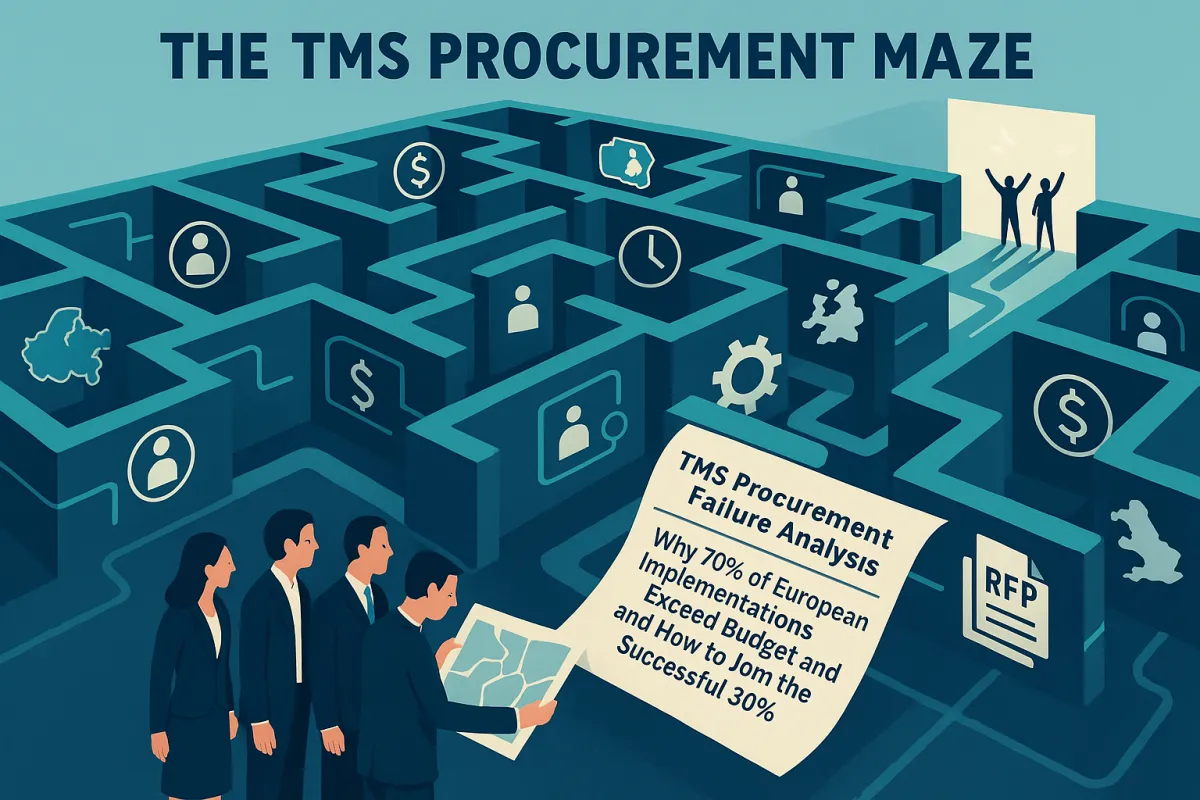
TMS Procurement Failure Analysis: Why 70% of European Implementations Exceed Budget and How to Join the Successful 30%

A German automotive parts manufacturer watched €800,000 disappear into their TMS implementation. Six months into implementation, €800,000 spent, they realized their new system couldn't handle their complex carrier network across 12 countries. They chose a North American-focused platform without considering European-specific requirements and discovered too late that their primary carriers couldn't integrate without costly custom development.
They're not alone. 76% of logistics transformations fail to achieve their performance objectives. Budget constraints and cost overruns often pose a challenge, as organizations strive to keep implementation costs within acceptable limits. These unforeseen expenses can lead to budget overruns and put strain on financial resources. The question European procurement teams face: how do you join the successful 30% when the majority of TMS procurement failures are preventable?
This analysis dissects why most European TMS implementations exceed budgets and miss objectives, while providing a framework to avoid these costly mistakes. The data comes from examining hundreds of failed implementations alongside regulatory pressure from eFTI regulation full implementation by July 2027 and mounting compliance costs.
The Three Critical Failure Points That Sink TMS Projects
Selection Phase Failures
Most European procurement teams make three fundamental errors during vendor selection. They underestimate operational complexity by assuming their transport network is simpler than it actually is. Most European shippers work with 20-30 regular carriers but could benefit from access to 200-300 qualified providers. Your selection criteria need to account for this complexity from day one.
Growth trajectory miscalculation represents another common mistake. Companies select TMS solutions based on current shipment volumes, not projected growth over the contract period. When volume doubles within two years, license costs and transaction fees scale proportionally, often exceeding budget allocations.
Business model misalignment creates the most expensive failures. Many shippers chose a sleek, modern, and inexpensive solution, only to discover it doesn't align with their workflow, leading to manual workarounds and even termination of the contract with the TMS vendor after a few months.
Implementation Phase Disasters
TMS implementation costs range from €30,000 to €900,000, depending on complexity and vendor approach. The wide range reflects how drastically implementations can exceed initial estimates when procurement teams underestimate integration complexity.
In nearly every TMS implementation I've been a part of in the past 30 years, the quantity of integrations is the #1 driver of implementation duration and cost. European shippers deal with multiple ERP systems, warehouse management platforms, and diverse carrier integration standards. Basic API integrations typically cost between $5,000 and $15,000, while connecting with complex ERP systems might exceed $50,000.
Carrier connectivity represents a hidden cost multiplier. Many carriers/forwarders are not willing or able to create the connection, and even if they are, they will most likely want to charge the integration cost to you. European shippers working with 20-30 regular carriers face substantial connectivity expenses that vendors rarely discuss during initial demos.
Adoption Phase Breakdowns
Implementation success doesn't guarantee operational success. User adoption failures account for roughly 40% of TMS disappointments, even when the technology works as promised. Teams resist changing established workflows, especially when new systems require additional training time during busy operational periods.
Change management receives insufficient attention during European implementations. Companies focus on technical integration while neglecting the human element. Change management often proves more challenging than technical implementation. Modern transport tender management through TMS platforms can reduce procurement cycle times by 60% while delivering measurable cost savings, but only if teams adapt their processes appropriately.
The Hidden Cost Categories Your Vendor Won't Disclose
European procurement teams are discovering a harsh reality: their TMS budget calculations are missing over half the true costs. License fees represent only the starting point for total cost calculations.
Recurring costs spread over 10+ years typically link directly to shipment volumes, while one-time implementation expenses hit immediately. The 5-year TCO framework requires calculating license fees, implementation services, carrier connectivity, customization, training, and support.
Consider these TCO components: base licensing (20-30% of total), implementation services (25-40%), carrier integration (15-25%), customization and training (10-20%), and ongoing support (15-20%).
Integration complexity creates the largest budget surprises. Many modern platforms rely on third-party solutions for capabilities like real-time visibility or parcel rate shopping, adding complexity and costs during both implementation and ongoing maintenance. These dependencies aren't apparent during vendor demonstrations but become expensive realities during deployment.
Carrier connectivity charges vary dramatically between vendors. Carrier connectivity represents one of the largest hidden cost areas. Some TMS providers offer published APIs for carrier integration, but carriers may charge shippers for establishing these connections. That makes having a TMS provider with a large, connected network and the ability to easily add new carriers/forwarders crucial to keep connectivity costs under control.
European data residency regulations add complexity and cost. Your TMS must handle GDPR compliance, data localization requirements, and cross-border data transfer restrictions. Cloud providers meeting these requirements often charge premium rates for European data centers.
European-Specific Procurement Pitfalls
European TMS procurement differs fundamentally from single-country implementations. Implementing a TMS in Germany is different from implementing one in Germany, France, Poland, and the Netherlands simultaneously. European shippers don't just need software that works—they need systems that handle 27 different VAT rates, multiple languages, varying carrier integration protocols, and soon, eFTI regulation compliance.
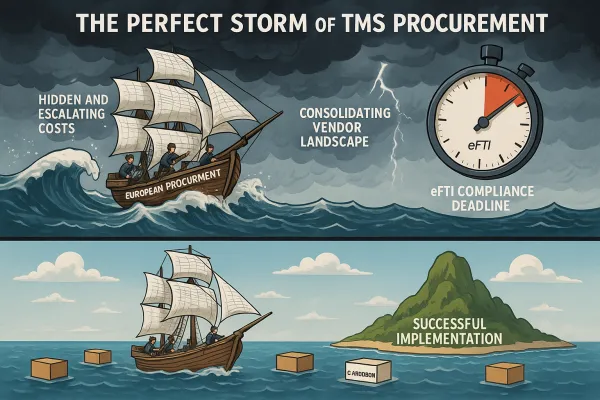
Regulatory timing pressure creates procurement urgency that leads to poor decisions. As of 9 July 2027: The eFTI Regulation will apply in full. Member State authorities must accept information shared electronically by operators via certified eFTI platforms. This deadline forces procurement timelines that don't allow for proper vendor evaluation.
Multi-country complexity requires different vendor capabilities. Carrier network: Connected to 80,000+ transport professionals across Europe. Carrier network: Builds true API/EDI connections with carriers, not just accounts in software or standardized EDI messages that carriers must implement themselves. Some vendors like Cargoson focus specifically on European shipper requirements, while others like MercuryGate or Oracle TM adapt North American platforms for European markets.
Currency and contract variations across EU markets create additional procurement complexity. Your TMS needs to handle multiple currencies within single shipments, different carrier payment terms, and varying documentation requirements for cross-border transport.
The Successful 30%: What They Do Differently
Companies avoiding TMS procurement failures share common characteristics in their approach. They treat implementation as business transformation, not technology purchase. Successful implementations from Transporeon, Oracle TM, and Alpega share common traits: conservative ROI projections, comprehensive cost accounting, and realistic timelines. The difference lies in treating the TMS as a business investment, not a technology purchase.
Comprehensive TCO modeling separates successful projects from failures. A well-optimized TMS typically generates 15 to 25% kilometer savings, but these gains can vary from 5% on already well-optimized routes to 40% on historically poorly planned routes. In 2025, with an average cost of €0.45 per kilometer for a utility vehicle, each kilometer saved represents a direct measurable gain.
Realistic benchmarking prevents over-promising ROI calculations. Successful companies document current manual processes and baseline existing efficiency levels before projecting improvements. They account for implementation time in their ROI calculations.
Implementation speed matters for ROI timing. Cloud-native solutions like Cargoson report 6-12 weeks to value, while enterprise platforms like Blue Yonder might require 6-12 months. Factor deployment duration into your business case and cash flow projections.
Vendor evaluation frameworks focus on European-specific capabilities. Can the platform handle multiple EDI standards used across different European markets? Does it support the documentation requirements for cross-border transport? Evaluate vendors like SAP TM for enterprise-grade European operations, Oracle TM for large-scale implementations, or Cargoson for mid-market European-focused operations. Each has different strengths in the European context.
The 2025 Procurement Decision Framework
Successful TMS procurement requires a structured approach that addresses European complexity from project inception. This four-phase framework prevents the most common failure points.
Phase 1: Requirements Assessment
Begin with operational complexity audit. Document your current carrier relationships, shipment volumes by mode, and integration requirements. Start by auditing your current carrier relationships and integration requirements. Most European shippers work with 20-30 regular carriers but could benefit from access to 200-300 qualified providers.
Growth trajectory analysis prevents license cost surprises. Project shipment volume increases over the contract period. Include seasonal variations and potential business expansion into new European markets.
Phase 2: True Cost Analysis
Use the TCO calculator template covering all cost categories: licensing, implementation services, carrier connectivity, customization, training, ongoing support, and regulatory compliance add-ons. Include eFTI compliance costs in your calculations.
Hidden cost checklist should examine carrier connectivity charges, third-party integration fees, data residency compliance costs, and change management overhead. Hidden Fees and Unforeseen Costs: Unanticipated expenses such as third-party integration charges, additional feature licensing, scaling costs, and penalties for contract breaches.
Phase 3: Vendor Evaluation
Scoring matrix should weight European-specific capabilities heavily. Include regulatory readiness for eFTI compliance. Platform readiness varies significantly. Oracle TM and SAP TM are developing eFTI modules, while Transporeon emphasizes API connectivity for compliance data sharing.
Evaluate carrier network depth, not just breadth. Key players address this differently. Cargoson offers direct API/EDI integrations with carriers across all transport modes, while Transporeon connects 150,000+ carriers but many integrations are standard EDIs or PDF/email transmissions rather than true API connections.
Phase 4: Risk Mitigation
Contract clauses should include implementation timeline guarantees, cost overrun protections, and change management support requirements. Specify eFTI compliance timeline requirements and vendor responsibilities for regulatory updates.
Implementation safeguards require phased deployment plans, success criteria definitions, and fallback procedures. The most successful migrations we've observed follow a phased approach: pilot with one major lane, measure results carefully, then expand systematically.
Action Plan: Your Next Steps to Avoid the 70% Failure Rate
Start your TMS procurement preparation immediately. The eFTI compliance deadline creates time pressure that forces rushed decisions when you delay vendor evaluation.
Immediate actions include conducting a comprehensive cost audit using the TCO framework and documenting detailed requirements including European-specific capabilities. Assess your current carrier relationships and integration complexity.
30-day plan should focus on vendor shortlisting using the provided evaluation matrix. Insist on customer references in similar industries with comparable shipment volumes and carrier complexity. Verify claimed automation rates, implementation timelines, and ongoing support satisfaction through direct customer conversations.
Implementation readiness checklist should cover cross-functional team formation, stakeholder alignment, and change management planning. Securing expert support during the initial implementation is essential for maximizing the benefits of your TMS, although it does involve effort and expense. While companies want to keep costs to a minimum, implementation costs that configure and connect the TMS correctly will allow you to reap the benefits from the TMS for the next 10+ years.
Red flags during vendor presentations include vague implementation timelines, unclear carrier connectivity costs, and lack of European regulatory expertise. Watch for vendors who can't provide specific European customer references or demonstrate eFTI compliance capabilities.
Start your eFTI preparation now. Assess your current capabilities, evaluate TMS options, and begin integration planning. The July 2027 deadline approaches faster than you think, and the benefits of early implementation extend far beyond regulatory compliance.
Remember: Your TMS procurement success depends on understanding these hidden costs upfront. European shippers who invest time in comprehensive TCO analysis avoid the budget disasters that plague hasty implementations. Don't become another €800,000 implementation failure story.