TMS Vendor Due Diligence Framework: The European Procurement Template That Prevents €2M+ Implementation Disasters in 2025's Consolidating Market


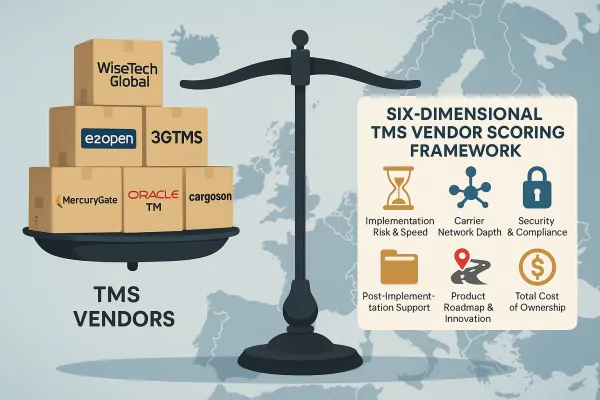
The TMS vendor due diligence framework has become critical for European procurement teams as market consolidation accelerates at an unprecedented pace. WiseTech Global's $2.1 billion acquisition of E2open is expected to be completed in 1H26, representing a strategically significant step in achieving their expanded vision to be the operating system for global trade and logistics. Meanwhile, Descartes Systems Group acquired the transportation management solutions (TMS) software vendor 3GTMS for $115 million in March 2025, marking Descartes' 32nd acquisition since 2016.
These massive consolidation moves create new procurement risks that traditional vendor evaluation methods fail to address. When two TMS platforms merge, procurement teams face product roadmap uncertainties, support structure changes, and potential pricing leverage shifts. This consolidation wave demands a more rigorous due diligence approach that evaluates not just current capabilities, but long-term vendor stability and regulatory compliance readiness.
The €2M+ Risk: What Happens When Due Diligence Fails
A German automotive parts manufacturer recently discovered what inadequate TMS vendor due diligence costs. Six months into deployment, they learned their €800,000 TMS implementation mistake when European carriers couldn't integrate without costly custom development. The total damage: re-implementation costs, lost productivity during transition, and competitive disadvantages while rivals gained pricing leverage they missed.
This example illustrates why traditional procurement approaches fall short in today's TMS market. The automotive manufacturer focused on feature comparisons and pricing negotiations but failed to assess integration architecture, carrier ecosystem compatibility, and regulatory compliance roadmaps. Their oversight cost more than the original TMS investment.
Sound procurement teams now evaluate vendors like Cargoson, SAP TM, Oracle TM, and Blue Yonder not just on current functionality, but on financial stability, compliance readiness, and implementation risk factors that determine long-term success.
Financial Stability Assessment in the Consolidation Era
Financial stability analysis has become the foundation of TMS vendor due diligence. The acquisition spree creates new risks: acquired vendors may face product discontinuation, support reduction, or forced platform migrations. Procurement teams need clear frameworks for evaluating vendor financial health beyond basic revenue figures.
Your financial stability assessment should examine three core areas: balance sheet strength, cash flow consistency, and debt-to-equity ratios. WiseTech's E2open acquisition lifts net gearing to 3.5 times, though integration and synergistic benefits could make it EPS-accretive in the first year. This metric reveals how acquisitions impact vendor stability.
For smaller vendors like Cargoson, financial transparency becomes a competitive differentiator. Look for vendors that provide clear financial disclosures, demonstrate consistent growth patterns, and maintain healthy cash reserves. Private equity-backed vendors require additional scrutiny of ownership structure and exit timeline pressures.
The key questions: Does the vendor generate positive operating cash flow? How much debt finances their growth? What's their customer retention rate during ownership transitions? These metrics predict vendor longevity better than feature specifications.
Red Flag Financial Indicators
Specific financial warning signs help procurement teams identify risky vendors before contract signature. Declining annual recurring revenue growth, increasing customer churn rates, and repeated leadership changes signal potential stability issues.
Recent market consolidation provides clear examples. E2open delivered a string of below-expectation earnings results, with management changes and a strategic review that contributed to the acquisition, according to analyst reports. These performance issues often precede acquisition discussions or vendor exits.
Regulatory Compliance Due Diligence: eFTI and CSRD Readiness
European TMS procurement now requires evaluation of regulatory compliance capabilities that weren't relevant 24 months ago. The eFTI Regulation will apply in full as of 9 July 2027, creating mandatory electronic freight transport information requirements across road, rail, inland waterway, and air transport.
eFTI compliance isn't optional functionality—it's a legal requirement that affects your entire multimodal network. The regulation mandates that authorities in all EU Member States will be required to accept electronic data when shared by businesses via eFTI-compliant platforms. Your TMS must integrate with certified platforms or provide native eFTI functionality.
Leading vendors are preparing differently. TMS providers like MercuryGate, Descartes, and Cargoson are already preparing eFTI-compatible solutions. The key differentiation lies in implementation approach: some vendors require third-party platform connections, adding integration costs and ongoing fees, while others offer native compliance capabilities.
CSRD requirements add another compliance layer. Large undertakings must submit their first CSRD-compliant sustainability reports in 2025 based on 2024 data, with expanded compliance requirements coming in 2026 covering all large undertakings. Your TMS vendor must support ESG data collection and reporting requirements.
The CSRD Delay Opportunity: Strengthening Due Diligence Now
Recent regulatory developments provide strategic breathing room for procurement teams. Large companies that are not public-interest entities, originally expected to report in 2026 for the 2025 financial year, will now be required to report for the financial year starting in 2027 with their first sustainability report published in 2028.
This timeline adjustment gives procurement teams additional time to strengthen vendor sustainability data infrastructure without compromising compliance deadlines. Use this window to evaluate which vendors offer robust ESG reporting capabilities and supply chain visibility tools.
The most prepared vendors will already have CSRD-compatible data collection systems, automated sustainability metrics tracking, and standardized ESG reporting modules. Cargoson and other forward-thinking providers position these capabilities as core platform features, not expensive add-ons.
Downloadable TMS Vendor Due Diligence Template
A comprehensive due diligence framework addresses six critical assessment categories: Financial Stability, Legal & Compliance, IT Security, Implementation Risk, ESG Readiness, and Market Position. Each category contains specific questions designed to reveal vendor strengths and weaknesses before contract signature.
Financial Stability (15 questions): Cash flow analysis, debt ratios, ownership structure, customer retention metrics, and acquisition risk indicators.
Legal & Compliance (12 questions): eFTI readiness timeline, CSRD compatibility, data residency requirements, regulatory change management, and intellectual property ownership.
IT Security (10 questions): SOC 2 Type II certification, penetration testing frequency, data encryption standards, backup procedures, and incident response protocols.
Implementation Risk (8 questions): Typical deployment timeline, integration complexity, change management support, and post-implementation risk mitigation.
ESG Readiness (5 questions): Sustainability data collection capabilities, supply chain transparency tools, and automated ESG reporting modules.
Red Flag Questions That Expose Hidden Risks
Certain questions consistently reveal vendor weaknesses that sales presentations obscure. Ask about technical debt levels in their platform architecture. Vendors struggling with legacy code issues will deflect or provide vague answers about modernization timelines.
Integration complexity questions expose vendors who promise seamless connectivity but require extensive custom development. Specifically ask: "How many APIs does our integration require? What's the typical integration timeline for companies with similar system complexity?"
Compliance gap questions reveal vendors unprepared for regulatory requirements. Ask about their eFTI certification timeline and CSRD data collection capabilities. Vendors without clear regulatory roadmaps represent significant implementation risk.
Implementation Risk Assessment Framework
Implementation speed varies dramatically across TMS vendors and deployment models. Cloud-based TMS solutions dominate the market, holding over 60% of the total share due to their scalability and real-time capabilities, with lower upfront costs and predictable monthly fees improving cash flow compared to traditional on-premise deployments.
Cloud-native vendors like Cargoson typically achieve go-live in 6-12 weeks, while enterprise platforms require 6-12 months for complex implementations. This timeline difference directly impacts TCO calculations and business disruption risk.
Your implementation risk assessment should evaluate vendor change management support, post-implementation performance guarantees, and rollback procedures. The most reliable vendors provide detailed implementation project plans, dedicated support teams, and clear success metrics.
The current market consolidation makes implementation timing even more critical. Product roadmap uncertainties are already surfacing. When two TMS platforms merge, customers inevitably face decisions about which system to standardize on, what features will be deprecated, and how long dual support will continue.
Choose vendors with transparent implementation processes, proven change management methodologies, and commitment to platform stability during market transitions. The additional scrutiny protects your investment and ensures successful deployment regardless of vendor market positioning changes.
Download our complete TMS Vendor Due Diligence Template to access the full 50-question framework with scoring guidance, risk assessment matrices, and vendor comparison tools. This template adapts for evaluating any TMS vendor, from global platforms to specialized European solutions like Cargoson.