TMS Vendor Overload: The Procurement Framework That Cuts Through 1,500+ Options to Find Your Perfect Match


The procurement headache starts innocently enough. Your finance director mentions the need for better freight visibility. Your supply chain manager complains about manual carrier selection. Three vendor demos later, you realize you're facing a selection process that makes choosing a new ERP look simple. The global transportation management system market reached $15.88 billion in 2024 and involves thousands of competing vendors, creating what many procurement teams describe as "analysis paralysis."
The numbers tell the story. Where the challenge comes into play for TMS buyers is because of the rapid growth in the market the options are exploding. The expectation is the TMS market is expected to grow 4 times larger between now and 2025. Yet this abundance of choice creates its own problems. Most procurement teams waste 3-6 months evaluating solutions that look similar on paper but deliver vastly different outcomes in practice.
Why Traditional Selection Methods Fall Short
The standard approach - collecting RFP responses from 10-15 vendors, scoring feature matrices, and conducting demos - misses the fundamental challenge in today's TMS landscape. Not all TMS vendors are created equal, yet the feature checklist approach treats them as interchangeable commodities.
Consider the differences between established players and newer entrants. The presence of various leading TMS vendors, including IBM Corporation, JDA Software Group Inc., Manhattan Associates, and MercuryGate International Inc. alongside cloud-first solutions like Cargoson, project44, and Transporeon represents fundamentally different approaches to transportation management. Legacy vendors often require extensive customization; newer platforms prioritize configuration over code modification.
The cost implications alone should reshape your evaluation criteria. Modern transportation management system solutions offered by the leading suppliers are highly configurable. Generally, there are rarely good reasons to customize the base code. Those customers that do end up paying for the customization experience the headaches associated with longer implementations and increased difficulty in upgrading their solutions.
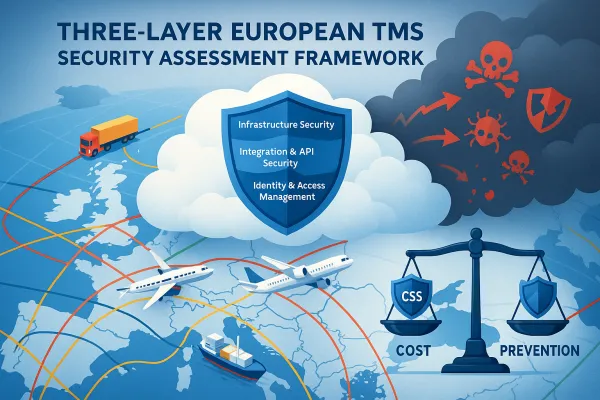
The Three-Layer Differentiation Framework
Effective vendor selection requires moving beyond surface-level feature comparisons to examine three critical layers that separate genuine solutions from marketing-heavy alternatives.
Layer 1: Market Position Analysis focuses on vendor DNA rather than feature lists. Does the vendor primarily serve shippers or carriers? Enterprise or mid-market? Their core customer base determines product priorities and development roadmaps. Cargoson built their platform specifically for European shippers managing complex multi-modal operations, while CH Robinson's Navisphere reflects their 3PL heritage. These architectural decisions matter more than individual feature comparisons.
Layer 2: Technology Architecture Assessment examines the technical foundation supporting vendor promises. A 'buy' solution will often come with out-of-the-box functionality and APIs, which can be used to accelerate work and integration with internal and external systems. However, vendor claims about "API-ready" systems often mask integration complexities that surface during implementation. Request technical architecture documentation, not just feature demos.
Layer 3: Business Model & Total Cost Evaluation reveals the true financial impact beyond license fees. When opting to buy a new TMS, initial one-off costs are usually significantly lower than the costs associated with in-house development. Keeping a legacy solution on the other hand does not require any upfront investments, but developing new functionality is typically slow and expensive. Factor in implementation services, ongoing maintenance, and the cost of vendor dependency.
Red Flags That Signal Vendor Saturation
Market saturation creates predictable patterns. Generic marketing messages replace specific value propositions. Vendors compete on price rather than solving actual business problems. The proliferation of "freemium" TMS options exemplifies this dynamic - limited functionality wrapped in aggressive pricing to capture market share.
Watch for vendors who struggle to articulate their differentiation beyond feature counts. Experience: Consider the vendor's experience and pedigree. A vendor with a deep understanding of your industry's challenges will be better equipped to provide a solution that meets your needs. Innovation: A vendor that is continuously improving their product and staying ahead of industry trends will be a more valuable partner in the long term.
Another warning signal: vendors who position their solution as suitable for "all industries and use cases." Transportation management involves sector-specific regulatory requirements, carrier relationships, and operational workflows that generic solutions handle poorly. Specialists like nShift (focused on e-commerce shipping) or Transporeon (freight network orchestration) often deliver better outcomes than "universal" platforms.
The Signal vs Noise Evaluation Matrix
Distinguishing meaningful capabilities from vendor marketing requires focused evaluation criteria. Proven integration capabilities matter more than theoretical API availability. Modern transportation management system solutions offered by the leading suppliers are highly configurable, but configuration flexibility varies dramatically between vendors.
Real-time visibility represents another area where vendor claims diverge from implementation reality. As he surveys the transportation landscape, Cunnane sees more companies seeking out real-time visibility solutions to help them better manage both transportation operations. Some vendors are stepping up to the plate, while others are in the early stages of embedding real-time visibility into their solutions. Cunnane says the urgency is palpable in this particular area.
Test vendor claims through specific scenarios. Request proof-of-concept implementations using your actual data and carrier relationships. Solutions like BluJay, Cargoson, and MercuryGate that demonstrate working integrations carry more weight than theoretical capabilities.
Practical Shortlisting Strategy
Depending on the system scope, the number of stages involved, available market knowledge, and the vendors' promptness, final selection is typically achieved in three to seven months. The RFI process is then conducted to narrow the initial list of 10 to 15 vendors down to between 3 and 5 for the next phase. However, starting with fewer vendors often produces better outcomes.
Begin with 3-5 vendors maximum based on clear selection criteria tied to your specific operational requirements. Retail-heavy shippers should prioritize parcel management capabilities. Cross-border operations require customs compliance and multi-currency support. Manufacturing companies need production schedule integration and inbound material visibility.
Use pilot projects to validate vendor claims before full commitment. Highly collaborate approach was adopted during the procurement process with pitches, demos and a proof of concept serving as regular touchpoints with the vendors. After a thorough and multi-phased RFP process, the best TMS solution and implementation partner were selected. This approach reveals implementation complexities that surface only during actual deployment.
Making the Final Decision
The most successful TMS implementations follow a phased approach rather than attempting comprehensive rollouts. Start with one major lane or operational area, measure results carefully, then expand systematically based on proven value delivery. This strategy reduces risk while providing concrete performance data for stakeholder presentations.
ARC's survey-based research found that respondents indicated freight savings of approximately 8 percent with the use of a TMS application. Of these savings, nearly 60 percent of users indicated that less than 10 percent of the net savings were absorbed by the TMS. These freight savings can be attributed to network design, load consolidation, multi-stop route optimization improved data for procurement, and freight audit.
Document your selection rationale thoroughly. Finance committees and board presentations require specific justification for technology investments exceeding typical software purchases. Include total cost models, implementation timelines, and risk mitigation strategies. Vendors like Transporeon, Cargoson, and MercuryGate that provide detailed ROI calculators and reference customer data simplify this documentation process.
Your procurement framework should favor proven solutions over ambitious promises. The TMS market's rapid growth attracts vendors making claims they cannot deliver. Focus on vendors demonstrating measurable results with customers facing similar operational challenges. The complexity of transportation management leaves little room for experimentation with unproven platforms.